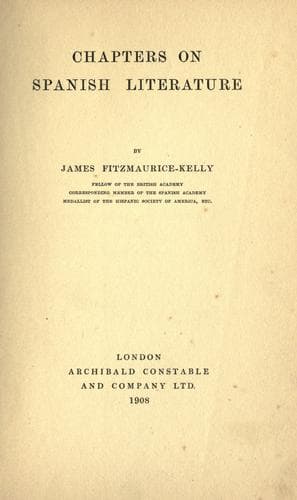
Chapters on Spanish LiteratureFitzmaurice-Kelly, James
History
Chapters on Spanish Literature
Fitzmaurice-Kelly, James
Spanish literature; Spanish literature -- History and criticism
It is certain that the Cid existed in the flesh. He was the son of
Diego Lainez, a soldier who fought in the Navarrese campaign. Pérez de
Guzmán, in the _Loores de los claros varones de España_, says that the
Cid was born at Río de Ovierna:—
Este varón tan notable
en Río de Ovierna[1] nasció.
But the usual version is that the Cid was born at Bivar near Burgos,
about the year 1040, and thence took his territorial designation.
To contemporaries he was first of all known simply as Rodrigo (or
Ruy) Díaz de Bivar—Roderick, son of James, of Bivar; and later, from
his prowess in single combat, as the _Campeador_ (the Champion or
Challenger). What was probably his earliest feat of this kind, the
overthrow of a Navarrese knight, is recorded in a copy of rudely rhymed
Latin verses, apparently the most ancient of the poems which were to
commemorate the Cid’s exploits:—
Eia! laetando, populi catervae,
Campi-doctoris hoc carmen audite!
Magis qui eius freti estis ope,
Cuncti venite!
Nobiliori de genere ortus,
Quod in Castella non est illo maius:
Hispalis novit et Iberum litus
Quis Rodericus.
Hoc fuit primum singulare bellum,
Cum adolescens devicit Navarrum:
Hinc Campi-doctor dictus est maiorum
Ore virorum.
The epithet gained at this early period clung to him through life: it
is applied to him even by his enemies. It is curious to find that the
Arab chroniclers constantly speak of him as Al-kambeyator, but never
as the Cid—a word which is usually said to derive from the Arabic
_Sidi_ (= My Lord). This circumstance makes it doubtful whether he was
widely known as the Cid during his own lifetime. There is, indeed, a
pleasing legend to the effect that the King of Castile, on hearing Ruy
Díaz de Bivar addressed as _Sidi_ by Arab prisoners of war, decreed
that the successful soldier should henceforth be known by that name.
But there is no evidence to support this story, and it is rather too
picturesque to be plausible. It seems more likely that Ruy Díaz de
Bivar was first addressed as _Sidi_ by Arabs who served under him or by
the Arab population of Valencia which he conquered towards the end of
his career, that the phrase was taken up by his Christian troops, and
that it was not generally current among Spaniards till after his death.
That he soon afterwards became widely known as ‘the Cid’ or ‘my Cid’
is apparent from a line in the rhymed Latin chronicle of the siege of
Almería, written some fifty years later:—
Ipse Rodericus, mio Cid semper vocatus.
Public-domain text, read in full here on John Shaqi.
Reviews
Reviews
No reviews yet
Be the first to share your thoughts on this work.
Join the Discussion
Join the discussion
Sign in to leave a comment or review.
Sign InorCreate an account