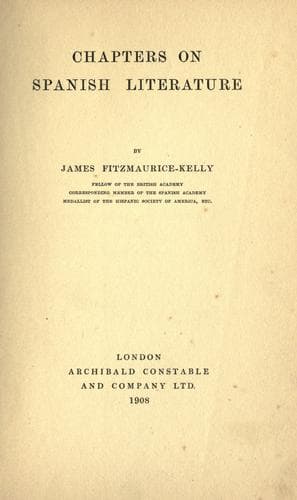
Chapters on Spanish LiteratureFitzmaurice-Kelly, James
History
Chapters on Spanish Literature
Fitzmaurice-Kelly, James
Spanish literature; Spanish literature -- History and criticism
speaks of these toothsome birds with a glow of epicurean eloquence.
But his ill luck pursued him even in his pleasures. His gluttony and
sedentary habits brought on repeated attacks of gout, and he died
prematurely at Madrid on December 15, 1434. As a man of letters he is
remarkable rather for his industry than for his performance. But there
is a certain picturesqueness about this enigmatic and rather futile
personage which invests him with a singular interest. It is not often
that a great noble who stands so near the throne cultivates learning
with steadfast zeal. In collecting manuscripts and texts Villena set
an example which was followed by Santillana, and by Luis de Guzmán, a
later and more fortunate Master of the Order of Calatrava. We cannot
doubt that, in his own undisciplined way, Villena loved literature and
things of the mind, and that by personal effort and by patronage he
helped a good cause which has never had too many friends.
A man of stronger fibre, nobler character, and far greater achievement
was Fernán Pérez de Guzmán, the nephew of the great Chancellor Pero
López de Ayala, and the uncle of Santillana. From a worldly point
of view, he, too, may be said to have wrecked his career; but the
charge of obsequiousness is the last that can be brought against him.
He was not of the stuff of which courtiers are made; his haughty
temper brought him into collision with Álvaro de Luna, whom he
detested; some of his relatives were in arms against Juan II., and
this circumstance, together with his uncompromising spirit, threw
suspicion on his personal loyalty to the throne. Such a man could not
fail to make enemies, and amongst those who intrigued against him we
may probably count that inventive busybody Pedro del Corral, whose
_Crónica Sarrazyna_ he afterwards described bluntly as a ‘mentira ó
trufa paladina.’ After a violent scene with Álvaro de Luna, Pérez
de Guzmán was arrested together with many of his sympathisers. On
his release, though not much past middle life, he closed the gates
of preferment on himself by withdrawing to his estate of Batres, and
thenceforth, like Villena, he sought in literature some consolation for
his disappointment. He had a most noble passion for fame, and he won it
with his pen, when fate compelled him to sheathe his sword.
Any one who takes up the poem entitled _Loores de los claros varones
de España_ and lights upon the unhappy passage in which Virgil is
condemned for tricking out his wishy-washy stuff with verbose ornament—
la poca é pobre sustancia
con verbosidad ornando—
Public-domain text, read in full here on John Shaqi.
Reviews
Reviews
No reviews yet
Be the first to share your thoughts on this work.
Join the Discussion
Join the discussion
Sign in to leave a comment or review.
Sign InorCreate an account