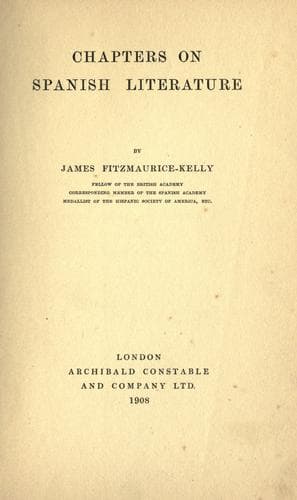
Chapters on Spanish LiteratureFitzmaurice-Kelly, James
History
Chapters on Spanish Literature
Fitzmaurice-Kelly, James
Spanish literature; Spanish literature -- History and criticism
He is believed to have died in 1460 at about the age of eighty-four,
and in any case he outlived his nephew Íñigo López de Mendoza, who is
always spoken of as the Marqués de Santillana, a title conferred on
him after the battle of Olmedo in 1445. In 1414, being then a boy of
eighteen, Santillana first comes into sight at the _jochs florals_ over
which Villena presided when Fernando de Antequera was crowned King of
Aragón; and thenceforward, till his death in 1458, Santillana is a
prominent figure on the stage of history. His father was Diego Hurtado
de Mendoza, Lord High Admiral of Castile; his mother was Leonor de la
Vega, superior to most men of her time, or of any time, in ability,
courage and determination. On both sides, he inherited position,
wealth, and literary traditions, and he utilised to the utmost his
advantages. He was no absent-minded dreamer: even in practical matters
his success was striking. During his long minority, his mother’s crafty
bravery had protected much of his estate from predatory relatives.
Santillana increased it, timing his political variations with a perfect
opportuneness. Beginning public life as a supporter of the Infantes
of Aragón, he deserted to Juan II. in 1429, and, when the property of
the Infantes was confiscated some five years later, he shared in the
spoil. Alienated by Álvaro de Luna’s methods, he veered round again in
1441, and took the field against Juan II.; once more he was reconciled,
and his services at Olmedo were rewarded by a marquessate and further
grants of land. Apparently his nearest approach to a political
conviction was a hatred of Álvaro de Luna in whose ruin he was actively
concerned; but Santillana was always on the safe side, and, before
declaring openly against Luna, he provided against failure by marrying
his eldest son to the Constable’s niece.
Baldly told, and without the extenuating pleas which partisanship
can furnish, the story of those profitable manoeuvres leaves an
unfavourable impression, which is deepened by Santillana’s vindictive
exultation over Álvaro de Luna in the _Doctrinal de privados_. But
we cannot expect generosity from a politician who has felt for years
that his head was not safe upon his shoulders. Yet Santillana’s
personality was engaging; he illustrated the old Spanish proverb which
he himself records: ‘Lance never blunted pen, nor pen lance.’ He
made comparatively few enemies while he lived, and all the world has
combined to praise him since his death in 1458. The slippery intriguer
is forgotten; the figure of the knight who appeared in the lists with
_Ave Maria_ on his shield has grown dim. But as a poet, as a patron of
literature, as the friend of Mena, as a type of the lettered noble
during the early Renaissance in Spain, Santillana is remembered as he
deserves to be.
Public-domain text, read in full here on John Shaqi.
Reviews
Reviews
No reviews yet
Be the first to share your thoughts on this work.
Join the Discussion
Join the discussion
Sign in to leave a comment or review.
Sign InorCreate an account