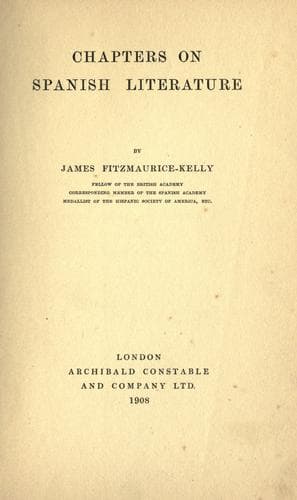
Chapters on Spanish LiteratureFitzmaurice-Kelly, James
History
Chapters on Spanish Literature
Fitzmaurice-Kelly, James
Spanish literature; Spanish literature -- History and criticism
This is thought by Sr. Menéndez y Pelayo to be, possibly, the
production of some soldier serving at Naples under Alfonso v. of
Aragón, and in any case it is of popular inspiration. Lorenzo de
Sepúlveda’s text contains an allusion to a page—_un pajecico_—whom
Alfonso is said to have loved better than himself, and the translator
was naturally puzzled by it. It is precisely by attention to some
such detail that we are often enabled to fix the date of composition;
and so it happens in the present instance. A fuller and better text
is given by Esteban de Nájera, who reads _un tal hermano_ for the
incomprehensible _un pajecico_. This reading makes the matter clear.
The reference is to the death of Alphonso v.’s brother Pedro; this
occurred in 1438, and the _romance_ was probably written not long
afterwards.
At this point Lockhart enters upon the series of border-ballads called
_romances fronterizos_, and he begins with a translation of
Reduan, bien se te acuerda que me distes la palabra,[57]
quoted by Ginés Pérez de Hita in the first part of his _Guerras civiles
de Granada_, published in 1595 under the title of _Historia de los
bandos de los Zegríes y Abencerrajes_.
Pérez de Hita speaks of it as ancient, and Lockhart is, of course, not
to blame for translating the ballad precisely as he found it in the
text before him. Any translator would be bound to do the same to-day if
he attempted a new rendering of the poem; but he would doubtless think
it advisable to state in a note the result of the critical analysis
which had scarcely been begun when Lockhart wrote. It now seems fairly
certain that Pérez de Hita ran two _romances_ into one, and that the
verses from the fourth stanza onwards in Lockhart—
They passed the Elvira gate, with banners all displayed—
are part of a ballad on Boabdil’s expedition against Lucena in 1483.
This martial narrative, describing the gorgeous squadrons of El
Rey Chico as they file past the towers of the Alhambra packed with
applauding Moorish ladies, reduces to insignificance _The Flight from
Granada_, though the translation is an improvement on Lorenzo de
Sepúlveda’s creaking original:—
En la ciudad de Granada grandes alaridos dan.[58]
The next in order is _The Death of Don Alonso de Aguilar_, a rendering
of
Estando el rey don Fernando en conquista de Granada.[59]
Public-domain text, read in full here on John Shaqi.
Reviews
Reviews
No reviews yet
Be the first to share your thoughts on this work.
Elsewhere in the archive
Join the Discussion
Join the discussion
Sign in to leave a comment or review.
Sign InorCreate an account