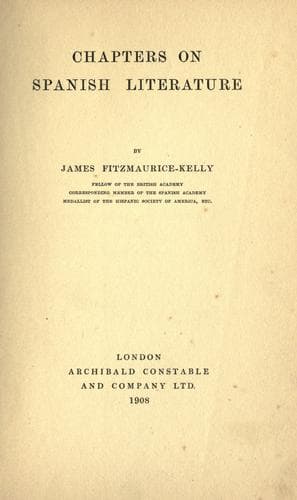
Chapters on Spanish LiteratureFitzmaurice-Kelly, James
History
Chapters on Spanish Literature
Fitzmaurice-Kelly, James
Spanish literature; Spanish literature -- History and criticism
This ballad commemorates the death of Alonso de Aguilar, elder brother
of ‘the great Captain’ Gonzalo de Córdoba, which took place in action
at Sierra Bermeja on May 18, 1501. This date is important. A serious
chronological mistake occurs in the opening line of the ballad, which
places Aguilar’s death before the surrender of Granada in 1492; and
this points to the conclusion that the _romance_ was not written till
long after the event, when the exact details had been forgotten. It
is of popular inspiration, no doubt, but it is clearly not ancient.
Still, in default of any other _romances fronterizos_, we receive it
gratefully. This section of Lockhart’s book is certainly the least
adequate.[60] The border-ballads which he gives are most of them
excellent, but unfortunately he gives us far too few of them. Some of
his omissions may be explained. He tells us in almost so many words
that he leaves out a later ballad on Aguilar’s death:—
¡Río Verde, río Verde, tinto vas en sangre viva![61]—
because there was already in existence an ‘exquisite version’ by the
Bishop of Dromore[62]—whom some of you may not instantly identify with
Thomas Percy, the editor of the _Reliques_. Most probably Lockhart
omitted a ballad with an effective refrain (perhaps borrowed from some
Arabic song)—
Paseábase el ray moro per la ciudad de Granada—
because it had been translated, though with no very striking success,
by Byron a little while before.[63] Nor can Lockhart be blamed for
omitting the oldest of the _romances fronterizos_:—
Cercada tiene á Baeza ese arráez Audalla Mir.[64]
Hidden in Argote de Molina’s _Nobleza de Andalucía_,[65] this ballad
was generally overlooked till 1899 when Sr. Menéndez y Pelayo did
us the good service of reprinting it. It still awaits an English
translator who, when he takes it in hand, may perhaps have something
destructive to say respecting its alleged date (1368). Such a
translator might also give us an English version of
Moricos, los mis moricos, los que ganáis mi soldada,[66]
which is thought to be the next oldest of these _romances fronterizos_.
Or he might attempt to render
Álora la bien cercada, tu que estás á par del río,[67]
which commemorates the death of Diego de Ribera during the siege of
Álora in 1434. A passage in the _Laberinto de Fortuna_ implies that
Ribera’s death was the theme of many popular songs in the time of
Juan de Mena,[68] and possibly the extant _romance_ may be taken to
represent them. There is another fine ballad on the historic victory of
the Infante Fernando (the first regent during Juan II.’s minority) at
Antequera in 1410:—
De Antequera partió el moro tres horas antes del dia.[69]
This also calls for translation, for all that we possess is Gibson’s
version of Timoneda’s recast, a copy of verses disfigured by superfine
interpolations:—
Public-domain text, read in full here on John Shaqi.
Reviews
Reviews
No reviews yet
Be the first to share your thoughts on this work.
Elsewhere in the archive
Join the Discussion
Join the discussion
Sign in to leave a comment or review.
Sign InorCreate an account