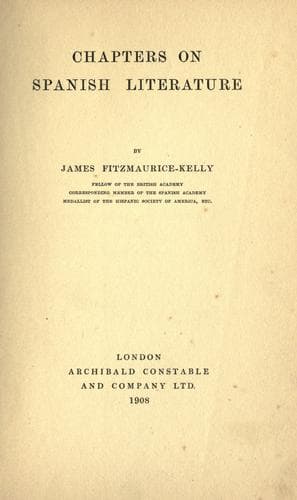
Chapters on Spanish LiteratureFitzmaurice-Kelly, James
History
Chapters on Spanish Literature
Fitzmaurice-Kelly, James
Spanish literature; Spanish literature -- History and criticism
Some men live their romances, and some men write them. It was given to
Cervantes to do both, and, as his art was not of the impersonal order,
it is scarcely possible to read his work without a desire to know more
of the rich and imposing individuality which informs it. Posthumous
legends are apt to form round men of the heroic type who have been
neglected while alive, and posterity seems to enjoy this cheap form of
atonement. Cervantes is a case in point. But the researches of the last
few years have brought much new material to light, and have dissipated
a cloud of myths concerning him: we are not yet able to see him as he
was at every stage of his chequered career, but we are nearer him than
we ever were before. We are passing out of the fogs of fable, and are
learning that, in Cervantes’s case, facts are as strange as fiction—and
far more interesting.
It is a foible with the biographers of great men to furnish their
heroes with a handsome equipment of ancestors, and Cervantes’s
descent has been traced back to the end of the tenth century by
these amateur genealogists. We may admire their industry, and reject
their conclusions. It is quite possible that Cervantes was of good
family, but we cannot go further back than two generations. His
grandfather, Juan de Cervantes, appears to have been a country lawyer
who died, without attaining distinction or fortune, about the middle
of the sixteenth century. Juan’s son was Rodrigo de Cervantes who
married Leonor de Cortinas: and the great novelist was the fourth
of their seven children. Rodrigo de Cervantes was a lowly precursor
of Sangrado—a simple apothecary-surgeon, of inferior professional
status, seldom settled long in one place, earning a precarious living
by cupping and blistering. His son Miguel was born at Alcalá de
Henares—possibly, as his name suggests, on St. Michael’s Day (September
29)—and he was baptized there on Sunday, October 9, 1547, in the
church of Santa María la Mayor. There was a tradition that Cervantes
matriculated at Alcalá, and his name was discovered in the university
registers by an investigator who looked for it with the eye of faith.
This is one of many pleasing, pious legends. Rodrigo de Cervantes was
not in a position to send his sons to universities. A poor, helpless,
sanguine man, he wandered in quest of patients and fortune from Alcalá
to Valladolid, from Valladolid to Madrid, from Madrid to Seville,
and it has been conjectured that Miguel de Cervantes Saavedra spent
some time in the Jesuit school at Seville. The dog Berganza, in the
_Coloquio de los Perros_, recalls his edification at ‘seeing the
loving-kindness, the discretion, the solicitude and the skill with
which those saintly fathers and masters taught these lads, so that the
tender shoots of their youth should not be twisted, nor take a wrong
bend in the path of virtue which, together with the humane letters,
they continually pointed out to them.’ But it is evident that Cervantes
Public-domain text, read in full here on John Shaqi.
Reviews
Reviews
No reviews yet
Be the first to share your thoughts on this work.
Elsewhere in the archive
Join the Discussion
Join the discussion
Sign in to leave a comment or review.
Sign InorCreate an account