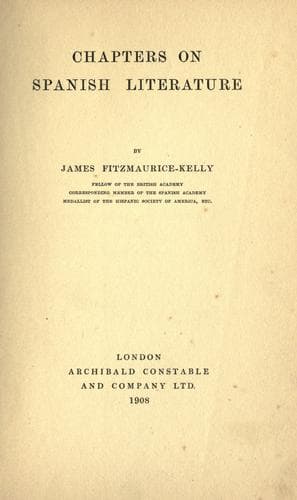
Chapters on Spanish LiteratureFitzmaurice-Kelly, James
History
Chapters on Spanish Literature
Fitzmaurice-Kelly, James
Spanish literature; Spanish literature -- History and criticism
can have had little formal schooling. He was educated in the university
of practical experience, and picked up his learning as he could.
He made the most of his casual opportunities. Obviously the man who
wrote _Don Quixote_ must have read the books of chivalry, the leading
poets, the chronicles, dramatic romances like the _Celestina_,
picaresque novels like _Lazarillo de Tormes_, pastoral tales like
the _Diana_, the _cancioneros_, and countless broadsides containing
popular ballads; and he must have read them at this time, for his
maturer years were spent in campaigning, or in the discharge of petty,
exacting duties. In his early youth, too, he made acquaintance with
the theatre, witnessing the performances of the enterprising Lope de
Rueda, actor, manager and playwright, the first man in Spain to set
up a travelling booth, and bid for public support. The impression was
ineffaceable: from Cervantes’s account of his experience, given half a
century later, it may be gathered that he listened and watched with the
uncritical rapture of a clever, ardent lad, and that his ambition to
become a successful dramatist was born there and then. In the meantime,
while following his father in his futile journeys, he received a
liberal education. Jogging along the high-road, lodging in wayside
inns, strolling in market-places, he met men and women of all ranks,
from nobles to peasants, and thus began to hoard his literary capital.
Like most young men of literary ambition, Cervantes began by
versifying, and, as he never grew old in heart, he versified as long
as he lived. A sonnet, written between 1560 and 1568, has come to
light recently, and is interesting solely as the earliest extant work
of Cervantes. By 1566 he was settled in Madrid, and two years later
he wrote a series of elegiacs on the death of the Queen, Isabel de
Valois: these were published in a volume edited by Juan López de
Hoyos, a Madrid schoolmaster, who refers to Cervantes as his ‘dear and
beloved pupil.’ As the pupil was twenty before López de Hoyos’s school
was founded, the meaning of the phrase is obscure. Perhaps Cervantes
had been a pupil under López de Hoyos elsewhere: perhaps he was an
usher in López de Hoyos’s new school: frankly, we know nothing of his
circumstances. He makes his formal entry into literature, and then
vanishes out of sight, and apparently out of Spain. What happened to
him at this time is obscure. We know on his own statement that he was
once _camarero_ to Cardinal Giulio Acquaviva; we know that Acquaviva,
not yet a Cardinal, was in Madrid during the winter of 1568, and that
he started for Rome towards the end of the year; and we know from
documentary evidence that Cervantes was in Rome at the end of the
following year. How he got there, how and when he entered Acquaviva’s
service, or when and why he left it—these, as Sir Thomas Browne would
say, are all ‘matters of probable conjecture.’
Public-domain text, read in full here on John Shaqi.
Reviews
Reviews
No reviews yet
Be the first to share your thoughts on this work.
Elsewhere in the archive
Join the Discussion
Join the discussion
Sign in to leave a comment or review.
Sign InorCreate an account