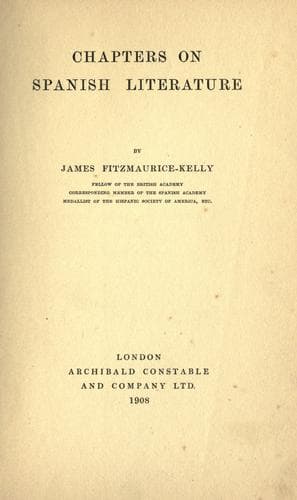
Chapters on Spanish LiteratureFitzmaurice-Kelly, James
History
Chapters on Spanish Literature
Fitzmaurice-Kelly, James
Spanish literature; Spanish literature -- History and criticism
a gain to us. In 1614 an apocryphal _Don Quixote_ was published at
Tarragona by Alonso Fernández de Avellaneda of whom nothing has been
discovered, and this spurious sequel contained a preface filled with
insolent personalities. If Cervantes had received any one of the
appointments in Spanish America for which he petitioned, we should
not have had the first _Don Quixote_; if he had gone to Naples with
Lemos we should never have had the second; if it had not been for
Avellaneda’s insults, we might have had only an unfinished sequel.
Cervantes’s life was now drawing to a close, but his industry was
prodigious. Apart from fugitive verses he was engaged on _Los Trabajos
de Persiles y Sigismunda_, on a play entitled _El Engaño á los ojos_,
the long-promised continuation of the _Galatea_, and two works which
he proposed to call _Las Semanas del Jardín_ and _El famoso Bernardo_.
All are lost to us except _Persiles y Sigismunda_ which appeared
posthumously in 1617.
We catch interesting glimpses of Cervantes in the last phase. He has
left a verbal portrait of himself as he looked when he was sixty-six,
and it is the only authentic portrait of him in existence. He was ‘of
aquiline features, with chestnut hair, smooth and unclouded brow,
bright eyes, and a nose arched, though well proportioned, silver beard,
once golden twenty years ago, long moustache, small mouth, teeth of
no consequence, since he had only six and these in ill condition and
worse placed, inasmuch as they do not correspond to one another;
stature about the average, neither tall nor short, ruddy complexion,
fair rather than dark, slightly stooped in the shoulders, and not very
active on his feet.’ Two years later Noel Brûlart de Sillery came to
Madrid on a special mission from the French Court, and his suite were
intensely curious to hear what they could of Cervantes; they learned
that he was ‘old, a soldier, a gentleman, and poor.’ At this time, his
health must have begun to fail: it was undoubtedly failing fast while
he wrote _Persiles y Sigismunda_. He was apparently dependent on the
bounty of Lemos and of Bernardo de Sandoval, the Cardinal-Archbishop
of Toledo. The hand of death was on him when he wrote to the Cardinal
on March 26, 1616, a letter expressing his gratitude for a recent
benefaction. On April 2 he was professed as a Tertiary of St. Francis,
and the profession took place at the house in the Calle de León to
which he had removed in 1611 or earlier. He was never to leave it
again alive: on April 18 he received Extreme Unction; on April 19 he
wrote the celebrated dedication of _Persiles y Sigismunda_ to Lemos;
on April 23 he died, and on April 24 he was buried in the convent of
the Trinitarian nuns in the Calle del Humilladero—the street which
now bears the name of his great rival Lope. His wife outlived him by
ten years, and his daughter by thirty-six; we hear no more of his
granddaughter after 1608. Presumably she died in infancy: if so, the
Public-domain text, read in full here on John Shaqi.
Reviews
Reviews
No reviews yet
Be the first to share your thoughts on this work.
Elsewhere in the archive
Join the Discussion
Join the discussion
Sign in to leave a comment or review.
Sign InorCreate an account