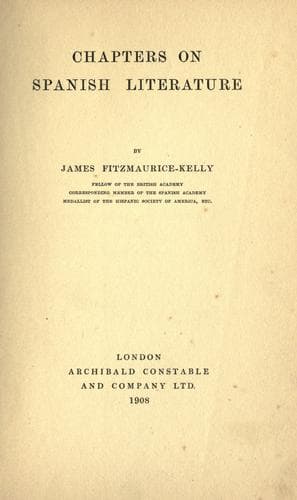
Chapters on Spanish LiteratureFitzmaurice-Kelly, James
History
Chapters on Spanish Literature
Fitzmaurice-Kelly, James
Spanish literature; Spanish literature -- History and criticism
family became extinct upon the death of Isabel de Saavedra in 1652.
Cervantes was no bloodless ascetic, no incarnation of dreary
righteousness: we do him wrong, if we present him in that crude,
intolerable light. With some defects of character and with some lapses
of conduct, he is a more interesting and more attractive personality
than if he were—what perhaps no one has ever been—a bundle of almost
impossible perfections. He was even as we are, but far nobler—braver,
more resigned to disappointment, more patient with the folly which
springs eternal in each of us. This inexhaustible sympathy, even more
than his splendid genius, is the secret of his conquering charm. He is
one of ourselves, only incomparably greater.
His life was gentle, and the elements
So mix’d in him that Nature might stand up
And say to all the world, ‘This was a man.’
But it is not for us to write his epitaph. He needs no marble
sepulchre, and he has none, for the precise spot where he rests is
unknown. He has built himself a lordlier and more imperishable monument
than we could fashion for him—a monument which will endure so long as
humour, wisdom, and romance enchant mankind.
CHAPTER VI
THE WORKS OF CERVANTES
The best and wisest of men have their delusions—especially with respect
to themselves and their capabilities—and Cervantes was not free from
such natural infirmities. He made his first appearance in literature
with a sonnet addressed to Philip II.’s third wife, Isabel de Valois,
and as this poem is not included in any Spanish edition of his works, I
make no apology for quoting it (in an English version by Norman MacColl
which has not yet been published).
Most Gracious Queen, within whose breast prevail
What thoughts to mortals by God’s grace do come,
Oh general refuge of Christendom,
Whose fame for piety can never fail.
Oh happy armour! with that well-meshed mail
Great Philip clothed himself, our sovereign,
Illustrious King of the broad lands of Spain,
Who fortune and the world holds in his baile.
What genius would adventure to proclaim
The good that thine example teaches us;
If thou wert summoned to the realms of day,
Who in thy mortal state put’st us to shame?
Better it is to feel and mutter ‘hush,’
Than what is difficult to say, aloud to say.
This is not a masterpiece in little, nor even a marvel of adroitness;
but it is highly interesting as the earliest extant effort of one who
was destined to become a master, and, moreover, it supplies us with his
favourite poetical formulæ. In his description of the Queen as the
general refuge of Christendom,
Whose fame for piety can never fail;
in his allusion to the
Illustrious King of the broad lands of Spain,
Who fortune and the world holds in his baile;
Public-domain text, read in full here on John Shaqi.
Reviews
Reviews
No reviews yet
Be the first to share your thoughts on this work.
Elsewhere in the archive
Join the Discussion
Join the discussion
Sign in to leave a comment or review.
Sign InorCreate an account