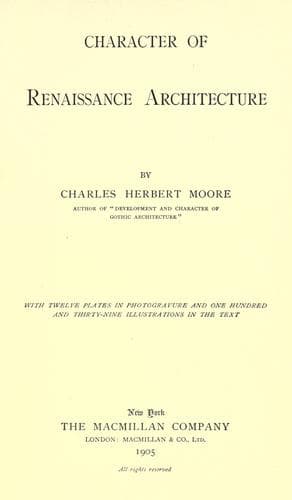
Character of Renaissance ArchitectureMoore, Charles Herbert
History
Character of Renaissance Architecture
Moore, Charles Herbert
Architecture, Renaissance
It is only by extension of the term that the architecture of England
in the seventeenth century may be properly called Renaissance. But
if, in architecture, we understand by Renaissance a revival of the
use of classic details, such extension is justifiable, for in this
architecture the use of classic details is becoming established,
and the art of Jones and Wren stands in relation to the Elizabethan
architecture as the art of Vignola and Palladio does to that of the
early Renaissance in Italy, and that of Lescot and De l’Orme to the
early French Renaissance.
Inigo Jones and Sir Christopher Wren were the only English architects
of great importance at this epoch. It was their genius that determined
the character of modern English architecture, and we may therefore
confine our attention to their works.
Of Jones, Horace Walpole thus speaks in his _Anecdotes of
Painting_:[157] “Inigo Jones, ... if a table of fame like that in
the _Tatler_ were to be framed for men of indisputable genius
in every country, would save England from the disgrace of not having
her representative among the arts.... Vitruvius drew up his grammar,
Palladio showed him the practice, Rome displayed a theatre worthy of
his emulation, and King Charles was ready to encourage, employ, and
reward his talents.” This famous architect began his artistic career
in the early part of the seventeenth century. Nothing is known of
his early education, but in youth he appears to have manifested an
inclination for drawing, and to have acquired some skill in landscape
painting.[158] He does not seem to have had any systematic training in
architecture, but in early life he travelled in Italy,[159] where he
studied the ancient monuments and read the works of Palladio and other
Italian authors. In a book entitled _Stonehenge Restored_,[160]
he says: “Being naturally inclined in my younger years to study the
arts of design, I passed into foreign parts to converse with the great
masters thereof in Italy, where I applied myself to search out the
ruins of those ancient buildings which, in despite of time itself, and
violence of barbarians, are yet remaining. Having satisfied myself
in these, and returning to my native country, I applied my mind more
particularly to the study of architecture.” For a quick-witted man with
architectural aptitudes no training could be better, except that of
growing up in an atmosphere of building activity, as the craftsmen of
the Middle Ages did.
Public-domain text, read in full here on John Shaqi.
Reviews
Reviews
No reviews yet
Be the first to share your thoughts on this work.
Elsewhere in the archive
Join the Discussion
Join the discussion
Sign in to leave a comment or review.
Sign InorCreate an account