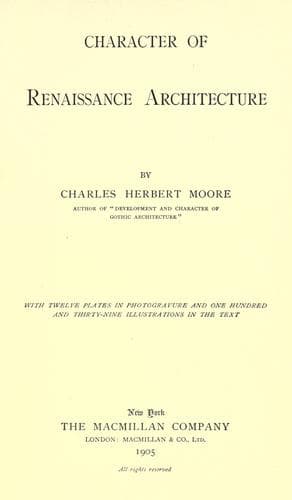
Character of Renaissance ArchitectureMoore, Charles Herbert
History
Character of Renaissance Architecture
Moore, Charles Herbert
Architecture, Renaissance
In his first practice Jones appears to have worked in a mixed style.
The mongrel Elizabethan art was still in full vogue, and with this
style, says Cunningham, “Inigo compounded, and for some time persevered
in what the wits of the succeeding age nicknamed King James’s Gothic.”
The well-known porch of St. Mary’s church, Oxford, if it be by Jones,
may furnish an example of this earlier style. But he soon sought to
free himself from the vagaries of the Elizabethan craftsman, and strove
to introduce a rigorous use of Palladian forms. He had learned the
grammar of the orders as formulated by the architects of the later
Renaissance, and had apparently conceived a sincere belief that the
Palladian canons embodied all that was most excellent in architectural
design. He saw in the Elizabethan art only its manifold infractions
of the rules of order and proportion, and its grotesque distortions
of classic forms. To reëstablish these rules and restore these forms
appeared to him the way to regenerate English art.
First among his extant works that can be certainly identified is the
well-known Banqueting Hall built in 1619, for King James I, as a part
of the projected palace of Whitehall, for which he had prepared the
plans on a vast scale. The first remark prompted by this design is that
it is not at all English. Every form and feature of the native art
is eliminated. The Elizabethan house, however overlaid with foreign
elements, was English in its primary forms and expression. But here
Inigo Jones swept away everything English, and substituted a Palladian
scheme that is foreign to England in every particular. The low-pitched
roof, the plain rectangular outline, and the narrow undivided
window openings are as Italian as the orders with which the façade
is overlaid. But such was the state of taste among the influential
classes that these features were approved, and the design was applauded
with acclamation. “It spread,” says Cunningham, “the love of classic
architecture far and wide, and there was soon a growing demand for
works which recalled Athens to the learned, and presented something
new to the admiration of the vulgar.”[161] The learned had then small
knowledge of Athenian architecture, and even now many learned people
fail to consider that there was never in Athens anything at all like
Palladian design.
Public-domain text, read in full here on John Shaqi.
Reviews
Reviews
No reviews yet
Be the first to share your thoughts on this work.
Elsewhere in the archive
Join the Discussion
Join the discussion
Sign in to leave a comment or review.
Sign InorCreate an account