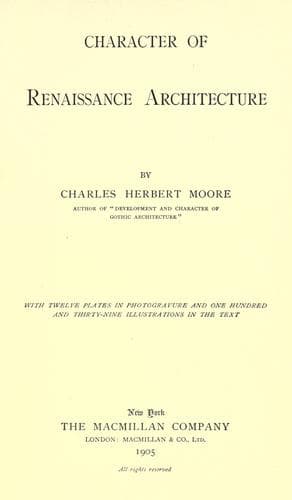
Character of Renaissance ArchitectureMoore, Charles Herbert
History
Character of Renaissance Architecture
Moore, Charles Herbert
Architecture, Renaissance
Of the architectural treatment of the exterior as a whole little need
be said further than that it has no relation to the real form of the
building. The masking of the buttress system by the false wall, and
the application of orders without any structural use or expression
in harmony with the real structure, are entirely in keeping with the
spirit the Renaissance.
Wren’s other churches exhibit a medley of elements from spurious Gothic
to pseudo-classic in manifold irrational combinations, such as can
be found in the works of few other architects. These churches with
their vaultings of wood and plaster--whether in the form of domes on
pendentives, sprung from the entablatures of classic orders, as at St.
Stephen’s, Walbrook, or with Welsh vaulting on simulated cross ribs
of plaster, as at St. Bride’s, Fleet Street, or with barrel vaulting
on an attic, as at St. Peter’s, Cornhill,--it would be superfluous,
as well as tiresome, to examine in detail. Nor is it worth while to
analyze the spires of these churches. Spires made up of superimposed
stories with classic entablatures in telescopic adjustment, like St.
Bride’s, or temples of Vesta crowned with flying buttresses holding up
neo-classic tabernacles surmounted by obelisks, like St. Mary-le-Bow,
are hybrid compositions of utterly barbaric character, notwithstanding
the excellent portions for which they have been justly admired.
CHAPTER XV
CONCLUSION
I think it must be clear, in the light of the foregoing considerations,
that the architecture of the Renaissance is an art without consistent
principles. We have seen that it assumed a great variety of phases at
different times and in different localities; but that it was never
either really classic or structurally truthful. While professing to
aim at restoring the “good ancient manner,” the neo-classic designers
rarely conformed to any ancient standards save, at most, in some
details of their compositions. They designed for the most part, as we
have seen, on a basis of mediæval forms, and overlaid their structures
with a facing of details derived, indeed, from classic sources, but
altered, mixed, and misapplied in all manner of unclassic ways. Of true
classic art, _i.e._ Greek art of the best time of Greek culture,
they had, as before remarked (p. 4), no knowledge. By the “good ancient
manner” they meant the imperial Roman manner. But even this they
did not faithfully follow. The wide departure from ancient modes of
design so constantly manifested in the neo-classic architecture has
not escaped notice by modern writers, who are wont to speak of it as
showing that the revivalists were not servile copyists, but inventive
designers adapting the ancient elements to new conditions. But there is
no justification for this view. As to essential forms of building there
were no new conditions to be met. In seeking to change architecture
Public-domain text, read in full here on John Shaqi.
Reviews
Reviews
No reviews yet
Be the first to share your thoughts on this work.
Elsewhere in the archive
Join the Discussion
Join the discussion
Sign in to leave a comment or review.
Sign InorCreate an account