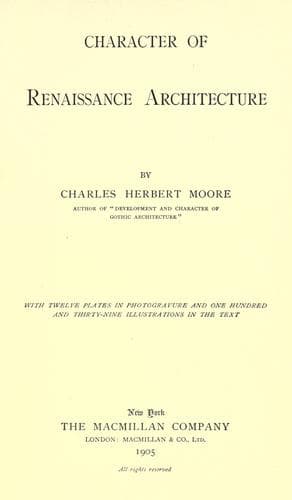
Character of Renaissance ArchitectureMoore, Charles Herbert
History
Character of Renaissance Architecture
Moore, Charles Herbert
Architecture, Renaissance
superficially by an application of classic details the neo-classicists
erred. They ought to have seen that classic details do not lend
themselves to new uses. Their very perfection for classic use unfits
them for any other. To distort and misadjust them, as the architects of
the Renaissance did, is not to adapt them. There was no true adaptation
of classic elements in Renaissance design. Such adaptation involves
creative modifications which so transform original elements that to a
superficial view they are not recognizable in the resulting forms. The
mediæval architects, through a long series of logical changes, growing
out of their remarkable structural evolution, magnificently transformed
the classic orders in a creative way. This the neo-classicists failed
to perceive, and because the mediæval details and adjustments did
not conform with those of Roman antiquity, they felt justified in
calling them barbaric, while it was they themselves who were guilty of
architectural barbarism.
The architects of the Renaissance were strangely inconsistent. While in
practice constantly violating the principles of classic design, they
were in theory ardently advocating these principles; and finding strict
canons of proportion laid down in the writings of Vitruvius, they
attached, as theorists, great importance to such canons. Thus arose the
elaborate systems of rules for the orders embodied in the writings of
Vignola, Palladio, and many others.
The influence of these short-sighted and mechanical Italian rules
has been great in modern times. The formidable body of architectural
dogma, contained in the literature of the Renaissance on this subject,
has been so widely accepted as authoritative that modern art has
been largely shaped by it. The so-called Palladian style of the
seventeenth century was derived mainly from the Italian books, and
the more recent teaching has been so implicitly based on the writings
of Vignola and Palladio that few architects of academic training have
thought of questioning the belief that the formulas of these writers
constitute the only true basis of correct design. Yet the fact that
these rules are arbitrary, and not in accord with the true principles
of ancient art, has occasionally been recognized. Thus in a book of
the eighteenth century, devoted in the main to the inculcation of the
Palladian doctrines,[178] the following remarks occur: “As it was
from the works of the antient architects that the several orders were
deduced, those who had studied and found their different characters
then became desirous of establishing from the same source their
proportions.... Perceiving consummate beauty in what they saw, they
sought to build upon that perfection certain fixed and invariable
rules, by the observing of which others might be sure of attaining the
same excellence.... But when they came to examine more of those works,
they found the antients had not confined themselves to any such laws;
Public-domain text, read in full here on John Shaqi.
Reviews
Reviews
No reviews yet
Be the first to share your thoughts on this work.
Elsewhere in the archive
Join the Discussion
Join the discussion
Sign in to leave a comment or review.
Sign InorCreate an account