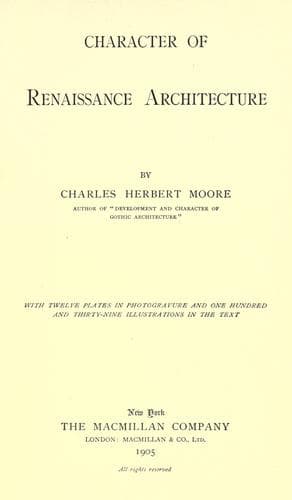
Character of Renaissance ArchitectureMoore, Charles Herbert
History
Character of Renaissance Architecture
Moore, Charles Herbert
Architecture, Renaissance
In the light of what we have seen I think it must appear that the
claims which have been advanced for the architecture of the Renaissance
as the only architecture of correct principles since that of classic
antiquity, and as an architecture in comparison with which the Gothic
art of the Middle Ages should be considered as the barbarous product
of an unenlightened age, are without justification. The mistaken
notions of the Italian writers of the fifteenth and sixteenth
centuries (labouring under strange misapprehension of the principles
of classic art on the one hand, and ignorance of the true Gothic on
the other) have been too much inculcated in our own time; and the
belief that classic art offers suitable models for modern uses, and
that the architecture of the Renaissance embodies classic principles,
has been accepted with too little examination of its grounds. A few
of the most competent modern authors, while in the main disposed,
by force of custom, to take a favourable view of the architecture
of the Renaissance, have occasionally shown a juster sense of its
real character. Thus the recent Italian writer Melani says:[182] “We
always admire the beautiful productions of the art of the Renaissance,
because we are accustomed to value the good wherever it is found; but
when we think of the absurdity of this art, and still worse, of the
consequences to which it has given rise, we cannot but deplore so much
ill-directed energy.”
APPENDIX
CONDITION OF THE DOME OF ST. PETER’S
The mathematicians, after describing the dome and its supports, make
the following statement of the condition in which they found it:[183]--
* * * * *
1. La base esteriore A del tamburo si vede piena di spaccature, molte
delle quali corrono unite in sù per tutto il tamburo medesimo, e per
tutto l’attico, fino a nascondersi in _nd_ sotto i piombi non
ancora scoperti. Da dette spaccature si diramano continui peli, che
infrangono una quantità grandissima di travertini.
2. Esse spaccature al fondo son piccolissime, e in sù van sempre
crescendo. Piegano dagli arconi in giù verso i piloni.
3. Nel Corridore CB, che gira dentro tutta la base si vedono sul muro
esteriore BE molte aperture, che parimente venendo in giù piegano verso
i piloni.
4. Nello stesso muro esteriore pure dentro il corridore si vedono
raddoppiate aperture orizontali verso il fondo B, che nell’alzarsi
il pavimento sopra gli arconi, si seppelliscono sotto al medesimo,
vedendosi ivi più che altrove lo stesso pavimento separato dal muro
esteriore; qual disunione è generale per tutto il corridore.
Public-domain text, read in full here on John Shaqi.
Reviews
Reviews
No reviews yet
Be the first to share your thoughts on this work.
Elsewhere in the archive
Join the Discussion
Join the discussion
Sign in to leave a comment or review.
Sign InorCreate an account