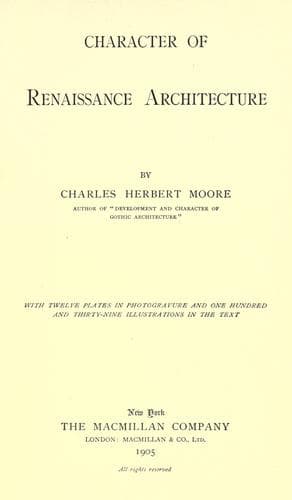
Character of Renaissance ArchitectureMoore, Charles Herbert
History
Character of Renaissance Architecture
Moore, Charles Herbert
Architecture, Renaissance
and therefore that it was impossible to build such rules upon their
works.... The young student is confused by reading a variety of authors
on the subject. Among a number of the best of these each delivers what
he esteems to be the most true and perfect proportion, but in each this
differs. All have founded their maxims upon something in the antique,
but, some having taken in the same order one piece, and some another,
these proportions vary extremely; for the antients so varied in their
works. Palladio is understood to be the best and greatest of these
authors, we shall therefore deliver his as the general and received
proportion in each order; but upon a general review of the several
remains in which that order is preserved, we shall add what is the
mean or middle proportion of the several parts, calculating from them
all. The modern architects too strictly and scrupulously follow these
antients; they did not so closely or servilely copy one another.”[179]
Such recognition of the difference between the theorists’ rules of
the orders and the ancient orders themselves is rare in the modern
literature of architecture. But the remedy proposed to relieve the
student from the confusion arising from the perusal of different
authors each of whom “delivers what he esteems to be the most true and
perfect proportion” is of little efficacy in practice; for the mean or
middle proportion would still impose a fixed rule, and the true artist
does not work by rules of any sort. The proportions of a genuine work
of art are determined by a sense of proportion that is governed by laws
too fine to be formulated, and which no rules can reach. It is his
natural sense of proportion, developed by observation and exercise,
that more than anything else makes an artist. Prescription may serve
in mechanical processes, but not in the production of works of art.
We may get Palladian formalism by rules, but no architecture of vital
character. A system of proportions that may be good in one case cannot
be good in any other, and therefore it is that “the antients” so varied
in their works. That rules are useless to an artist the Italian writer
Baldinucci, in his book on the proportions of the human figure,[180]
has well remarked. He says on this point: “It is true that all these
proportions, whether in painting or in sculpture, must be subject to
the correction of the eye, so that proportions ought to be adopted
always with its approval, notwithstanding all fixed rules, seeing that
this has been the custom of all the best artists, confirmed by the
memorable saying of the great Buonarroti that it is necessary for the
master to have the compass in his eye.”[181]
Public-domain text, read in full here on John Shaqi.
Reviews
Reviews
No reviews yet
Be the first to share your thoughts on this work.
Elsewhere in the archive
Join the Discussion
Join the discussion
Sign in to leave a comment or review.
Sign InorCreate an account