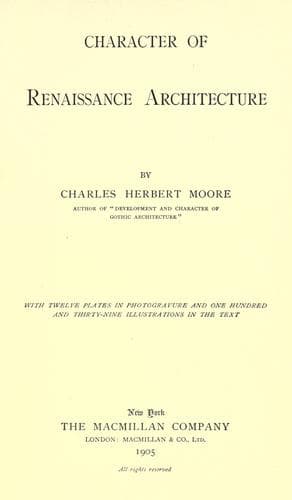
Character of Renaissance ArchitectureMoore, Charles Herbert
History
Character of Renaissance Architecture
Moore, Charles Herbert
Architecture, Renaissance
moderation shown in, 103, 110,
façade, 103,
window openings, 103,
arcades of interior court, 104;
Palazzo Rucellai, 107, 108 (cut),
application of classic orders, 108, 112,
window openings, 109,
rustication of the masonry, 109,
resemblance between Palazzo Cancelleria and, 112, 114;
Palazzo Strozzi, 106,
cornice, 106,
fortress-like character, 106;
the Strozzino, 106;
Palazzo Vecchio, 102.
Florentine Renaissance, church architecture of the, 26–43 (cuts and
plate);
palace architecture, 102–111 (cuts and plate);
_see_ Renaissance architecture.
Foliation, the finest feature of Renaissance architectural carving,
174.
Fontana, Carlo, cited on dome of Pisa, 13^1;
cited on stability of Florence dome, 23^3;
quoted on Michael Angelo, 55^1, 24^1;
cited on safety of St. Peter’s dome, 59;
_Il Tempio Vaticano e sua Origine_, etc., Discritto dal Cav.
Carlo Fontana, etc., 71^2;
cited on short-sighted admiration of St. Peter’s, 71;
cited on binding chains, 74.
France, Châteaux of, _see_ Renaissance in France.
Castle Châteaudun, portal and bay in the Flamboyant Gothic style,
184 (cut).
Château of Azay le Rideau, 182–187 (cuts);
general description, 182–184;
portal and bay of characteristic French Renaissance design in
which neo-classic details are worked into a pseudo-Gothic
scheme, 184–187 (cut);
window openings, 186;
one of the finest monuments of the early Renaissance in the
country, 187;
portal, 214.
Château of Blois, cornice with neo-classic and mediæval elements
combined, 182, (cut);
court façade, 188–190 (cut);
superimposed orders of pilasters of the court façade ornamented
with bead mouldings, 188 (cut);
polygonal staircase tower, 190 (cut);
garden façade, 190;
open gallery of, 191.
Château of Chambord, its multiplicity of soaring features
resembles a late Gothic building, 191;
resemblance of Longford Castle, England, to, 221.
Château of Charleval, 209–213 (cuts);
exterior façade, pilasters which have no entablature to
support, 210;
unmeaning variation of the detail of the several bays, 210;
interior façade, the division of the building into two stories
not expressed on the outside, 211;
court of Kirby Hall, England, resembles, 218.
Château of Chenonceaux, portal where Flamboyant idea is treated
in neo-classic details, 188 (cut).
Château of Écouen, architectural scheme is comparatively simple,
191;
in the portico of the court is reproduced the order of a Roman
temple without admixture of mediæval details or Italian
Public-domain text, read in full here on John Shaqi.
Reviews
Reviews
No reviews yet
Be the first to share your thoughts on this work.
Elsewhere in the archive
Join the Discussion
Join the discussion
Sign in to leave a comment or review.
Sign InorCreate an account