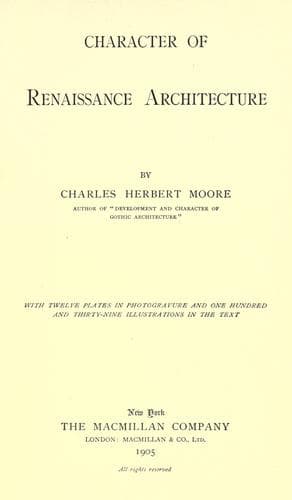
Character of Renaissance ArchitectureMoore, Charles Herbert
History
Character of Renaissance Architecture
Moore, Charles Herbert
Architecture, Renaissance
corruptions, 192.
Château of Fontainebleau follows the general character of early
French Renaissance, 191.
Château of La Rochefoucauld, arcades of the court where
Flamboyant arches are framed with pilasters, 188;
open gallery, 191.
Château of St. Germain en Laye, 192, 193;
buttresses, 192;
window openings, 192.
Villers Cotterets, column claimed by De l’Orme as his own
invention, 202 (cut).
French architecture, Renaissance influence upon, 179.
French Renaissance. _See_ Renaissance in France.
Frieze, problem of the arrangement of metope and triglyph at the
end of, 121, 122 (cuts);
of library of St. Mark, Venice, 123 (cut).
Galleries, open, covered by extension of the main roof in French
châteaux, 191.
Genoa, portal containing columns claimed by De l’Orme as his own
invention, 206.
Geymüller, Baron H. von, _Die ursprünglichen Entwürf für Sanct
Peter in Rom_, 47^2, 49^2.
Gisors, Church of SS. Gervais and Protais, the west front
Flamboyant Gothic with incongruous Renaissance details, 214.
Gotch, _Architecture of the Renaissance in England_, 217^1;
cited on Kirby Hall, England, 218^3;
on Longford Castle, England, 221;
on Tixall Castle, 222;
on Stanway, Westwood Park, Wollaton Hall, 223.
Gothic, King James’s, 227.
Gothic architectural carving, has at once an appropriate
architectural character and a high degree of excellence in the
development of form, 167, 172;
foliation, 176;
the grotesque, 177.
_Gothic architecture, development and character of_ cited, 7^1;
cited on dome of Salamanca, 57^2, 59^2;
cited on early stage of apsidal vault development, 59^1.
Gothic architecture, one of the three distinctive styles of
architecture, 6;
beauty and structural logic of, 7;
use of wooden ties, 22^2;
why a dome cannot have the character of a Gothic vault, 20, 21,
56–59 (cuts);
variety which arises through some new constructive idea, 211^1;
French Renaissance châteaux in which distorted neo-classic
details are worked into a pseudo-Gothic scheme, 184;
Wren’s scheme to reconcile the Gothic to a better manner, 238,
243, 245.
Gothic art forms a new French order, a true evolution out of the
ancient orders superbly adapted to new conditions, 206.
Goujon, sculptures of the fountain of the Innocents, Paris, 196.
Greek architectural carving, vitality of, 169 (cut), 171, 174
(cut);
beauty of leafage, 174, 176 (cuts).
Greek architecture, the classic style which was followed in
Renaissance architecture was that of the decadent Greek schools
as represented in Roman copies, 4, 247;
the only proper use of the classic order made in, 43.
Public-domain text, read in full here on John Shaqi.
Reviews
Reviews
No reviews yet
Be the first to share your thoughts on this work.
Elsewhere in the archive
Join the Discussion
Join the discussion
Sign in to leave a comment or review.
Sign InorCreate an account