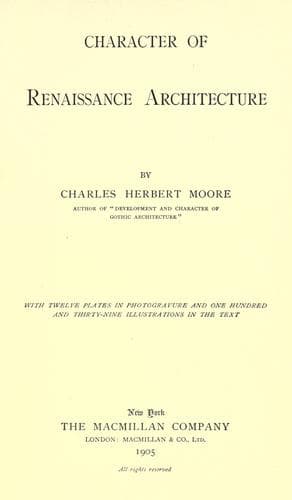
Character of Renaissance ArchitectureMoore, Charles Herbert
History
Character of Renaissance Architecture
Moore, Charles Herbert
Architecture, Renaissance
Order, classic, use of without structural meaning in Renaissance
architecture, 6, 29, 43, 244;
Brunelleschi’s use of, 26;
unsuitable for a building of mediæval character, 29, 43;
disposition of, in various Renaissance façades, 42;
misapplication and distortion of by Italians of the Renaissance,
43;
used with propriety by the Greeks alone, 43;
the usual size of, compared with that of St. Peter’s, Rome, 67;
Vignola’s treatise on the Five Orders, 84;
the proportions of the, altered by Vignola, 85;
Vitruvius quoted on maintaining the purity of, 86;
inappropriate in a church interior, 98;
application of, in palace architecture, 107, 109;
Renaissance innovation in spacing the columns of, 112, 114;
podium introduced beneath, 112;
where the columns of, act somewhat as buttresses, 131;
aberrations and makeshifts made necessary by efforts to apply the
classic orders to uses for which they were not adapted, 244;
transformed by the mediæval architects in a creative way, 248;
De l’Orme’s claim of having invented a new order, which he called
the French order, 202 (cut), 206.
Of the Parthenon, Athens, 67;
the Temple of the Sun at Baalbek, 67^1;
chapel of the Pazzi, Florence, 29, 30 (cut);
ch. of Santa Maria Novella, Florence, 35, 42 (cut);
Palazzo Rucellai, Florence, 108, 109 (cut);
St. Paul’s, London, interior, difficulties of combining
neo-classic style of, with the high vaulting, 243, 244;
Whitehall, banqueting hall, London, 228 (plate), 229 (cut),
230;
ch. of Sant’Andrea of Mantua, 40 (cut), 42;
ch. of San Biagio at Montepulciano, 78, 81 (cuts);
Duomo of Pienza, 42;
St. Peter’s, Rome, interior, 53, 66,
dwarfs the effect of magnitude in the interior, 67,
size compared with that of the Parthenon and Pantheon, 67,
diminishes the effect of altitude of the vaulting, 68;
Palazzo Cancelleria, Rome, podium introduced beneath, 112,
innovation in spacing the columns of, 113;
court of Palazzo Farnese, Rome, treatment of the capital, 118;
ch. of San Francesco della Vigna, Venice, 100;
ch. of San Giorgio Maggiore, Venice, raised on pedestals, 98,
101,
placed under the archivolts, 98;
library of St. Mark, Venice, 122, 123 (cuts);
Palazzo Contarini, Venice, 161;
Palazzo Vendramini, Venice, full orders in all three stories of
façade, 161, 162,
arrangement in lateral bay of façade, 162;
town hall portico of Vicenza, the columns of, act somewhat as
buttresses, 130, 131.
_See_ Columns.
Ornamentation, architectural, use of artificial elements in,
172–174 (cuts);
use of forms drawn from organic nature, 174.
_See_ Carving, architectural.
Public-domain text, read in full here on John Shaqi.
Reviews
Reviews
No reviews yet
Be the first to share your thoughts on this work.
Elsewhere in the archive
Join the Discussion
Join the discussion
Sign in to leave a comment or review.
Sign InorCreate an account