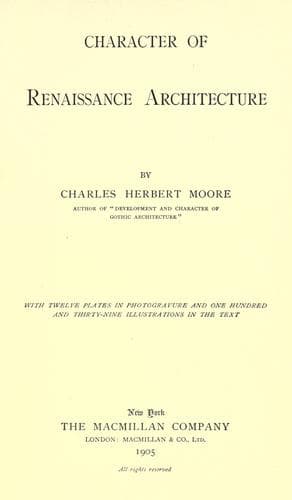
Character of Renaissance ArchitectureMoore, Charles Herbert
History
Character of Renaissance Architecture
Moore, Charles Herbert
Architecture, Renaissance
Oxford, St. Mary’s Church, porch, mentioned, 227;
Sheldonian theatre, Wren quoted on, 234.
Padua, town hall, Palladio’s scheme for town hall of Vicenza
derived from, 130, 131.
Painting, Italian genius for, 6, 7;
most Renaissance architects were painters and sculptors, 6, 7,
84, 96.
Palace architecture of the Renaissance, Florentine, 102–111 (cuts
and plate);
Roman, 112–134 (cuts);
of North Italy, 154–166 (cuts);
Venetian, 154–163 (cuts).
_See_ Renaissance architecture.
Palladian architecture, 95;
introduced into England by Jones, 227;
far from true to classic design, 228, 230;
rules are arbitrary and not in accord with the true principles of
ancient art, 248.
Palladio, _Quattro libri dell’Architettura di Andrea Palladio_,
96^4;
his influence greater than that of any other architect of the
Renaissance, 95, 248;
quoted on his study of architecture, 96, 97;
quoted on his admiration of his own work, 131^1;
his compositions based on order and symmetry of a mechanical
kind, 133;
concerned with the superficial appearance in architecture, 133;
ch. of San Francesco della Vigna, Venice, 100;
ch. of San Giorgio Maggiore, Venice, 97–100 (cuts);
ch. of the Redentore, Venice, 100 (cut);
Palazzo Valmarana, Venice, 133;
Loggia Bernarda, Vicenza, 133 (cut);
Palazzo Colleone-Porta, Vicenza, 133;
Palazzo Porta-Barbarano, Vicenza, 133;
the portico of the town hall, Vicenza, 130–132 (cut).
Pallaiuolo, Simone, Palazzo Guardagni, Florence, 107.
Palustre, Leon, _L’Architecture de la Renaissance_, 89^2;
quoted on the entablature of St. Andrea di Ponte Molle, Rome, 89.
Paris, Church of St. Etienne du Mont, of Flamboyant Gothic form,
with neo-classic west front and central portal, 213, 214;
portal with columns modelled after those claimed by De l’Orme as
his own invention, 214.
Church of St. Eustache, a Gothic structure overlaid with
Renaissance details, 213.
Fountain of the Innocents, 194–196 (cut);
a reproduction of the scheme of a Roman triumphal arch, 196.
Hotel Cluny, a forerunner of the Renaissance châteaux, 180.
Louvre, Lescot’s work on the west wing, 196–200 (cut);
orders, 198, 199;
the salient pavilions, have no function, 198;
breaking of the entablature in, 199;
sculptured festoons heavy and formal, 199.
Palace of the Tuileries, work of De l’Orme, 200–207 (cuts);
peculiar form of column claimed by De l’Orme as his invention,
201–206 (cut);
basement arcade, 207;
attic story, 207.
Parthenon, metal clamps in masonry, 22^2;
effect of a dome erected on, 89.
Public-domain text, read in full here on John Shaqi.
Reviews
Reviews
No reviews yet
Be the first to share your thoughts on this work.
Elsewhere in the archive
Join the Discussion
Join the discussion
Sign in to leave a comment or review.
Sign InorCreate an account