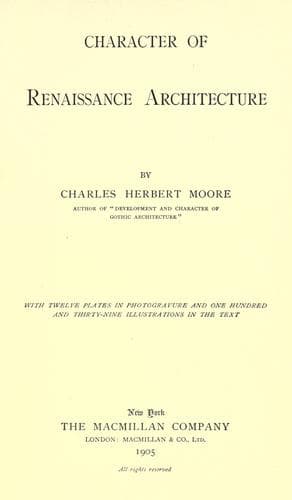
Character of Renaissance ArchitectureMoore, Charles Herbert
History
Character of Renaissance Architecture
Moore, Charles Herbert
Architecture, Renaissance
upper story, 123, 130.
Loggetta of the Campanile, 123.
Scuola di San Marco, description of façade, 156–158 (cut);
portal, described, unreason of its composition, 156 (cut);
carvings, 157.
Scuola di San Rocco, façade described, 158 (cut);
portal, 159;
window openings with mediæval features and others with
pseudo-Corinthian colonnettes, 159 (cut), 160.
The Zecca, form of column claimed by De l’Orme as his own
invention, 205.
Verona, church of San Zeno, porch and portal, 146 (cut).
Palazzo Bevilacqua, description of façade, 126, 127 (cut).
Palazzo Canalla, 126.
Palazzo del Consiglio, 163 (plate);
presents a mediæval broletto scheme dressed out in Renaissance
details, 163;
in respect to its finest qualities it belongs to the Middle
Ages, 163.
Palazzo Pompei alla Vittoria, 126.
Porta del Palio, description of façades, 125 (cut), 126.
Vicenza, Town hall portico by Palladio, 130–132 (cut);
use of free-standing columns under the archivolts, 130;
columns of the great orders act somewhat as buttresses, 131.
Palazzo Colleone-Porta, 133.
Palazzo Porta-Barbarano, 133.
Palazzo Valmarano, 133.
Loggia Bernarda, 133 (cut).
Vignola, _I Cinque Ordini d’Architettura_, 84, 85, 92;
entablature which he calls his own invention, 85 (cut);
his unclassic and incongruous combinations, 86, 95;
eliminates mediæval forms, 92;
tablet from, 95 (cut);
great influence of his writings, 248;
ch. of Sant’Andrea di Ponte Molle, Rome, 86–89 (cuts), 92;
ch. of Santa Maria degli Angeli, Assisi, 89;
ch. of the Gesù, Rome, 91–95 (cuts);
Palazzo Caprarola, near Viterbo, 128.
Violette-le-Duc, _S. V. Château_, 171^1, 181^1;
_Entretiens sur l’Architecture_, 207^3;
quoted on French architects of the Renaissance, 179^1;
quoted on château of Chambord, 191;
quoted on De l’Orme, 200^1;
his genius more scientific than artistic, 200^1;
quoted on the château of Charleval, 211, 212;
errs in his reasoning in his discourse on Renaissance
architecture, 211–213.
Villani, quoted, 2.
Villari, cited, 3^1.
Viterbo, Palazzo Caprarola, near Viterbo, general description of,
128–130;
a source of inspiration to later architects of trans-alpine
Renaissance, 130.
Vitruvius, 85;
quoted on the orders, 86;
taken by Palladio as his master, 96, 97;
later Renaissance architects based their practice on the writings
of, 119;
cited on meaningless Roman ornamental designs, 170^1;
notion that the Ionic order was designed after female
proportions, derived from, 207^1.
Public-domain text, read in full here on John Shaqi.
Reviews
Reviews
No reviews yet
Be the first to share your thoughts on this work.
Elsewhere in the archive
Join the Discussion
Join the discussion
Sign in to leave a comment or review.
Sign InorCreate an account