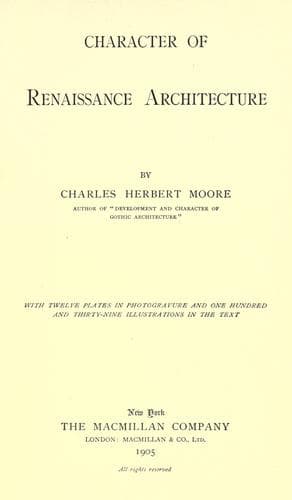
Character of Renaissance ArchitectureMoore, Charles Herbert
History
Character of Renaissance Architecture
Moore, Charles Herbert
Architecture, Renaissance
Walpole, Horace, _Anecdotes of Painting_, 226;
quoted on Inigo Jones, 226, 229;
quoted on faults of Jones’s façade of old St. Paul’s, London,
231, 232.
Ware, Isaac, _A Complete Body of Architecture_, 248^1, 249^1;
quoted on the rules of ancient architects, 248, 249.
Wenz, Paul, _Die Kuppel des Domes Santa Maria del Fiore zu
Florenz_, 20^1.
Willis, his term “continuous impost” used, 188^1.
Window openings, framed by structural members without structural
meaning, 116;
a peculiar form of compound, sometimes called an invention of
Scamozzi, 134 (cut), 143;
the same form occurs in the basilica of Shakka, 134 (cut);
tapering jamb shafts, 137 (cut), 142, 149;
illogical scheme of, which became characteristic of Lombard and
Venetian Renaissance architecture, 148 (cut);
mediæval form of those in Venetian palaces, 159 (cut), 160, 162;
Lower Walterstone Hall, England, illustrates Elizabethan
neo-classic ornamentation, 221 (cut);
château of Azay le Rideau, France, Flamboyant Gothic and
neo-classic forms combined, 186 (cut);
château of Charleval, France, unmeaning variation of details,
210, 211 (cut);
Palazzo Bartolini, Florence, 109 (cut);
Palazzo Guardagni, Florence, 107;
the Quaratesi, Florence, 106;
the Riccardi, Florence, mediæval in their larger features, but
with tapering jamb shafts, 103;
Palazzo Rucellai, Florence, 109 (cut);
Ospedale Maggiore, Milan, 165 (cut);
of the Certosa of Pavia, tapering jamb shafts, 137 (cut);
Palazzo Cancelleria, 112 (cut);
of Palazzo Farnese, Rome, framed by structural members without
structural meaning, 116 (cut);
Ducal Palace, Venice, east side of court, 154;
north side, pseudo-Corinthian order of, 155 (cut);
Palazzo Contarini, Venice, grouping of the pilasters, 161 (cut);
Palazzo Corner-Spinelli, Venice, mediæval features, incomplete
circle in the tympanum space, 160;
Palazzo Corneri, Venice, 124 (cut);
Palazzo Vendramini, Venice, grouping of, in the bays of the
façade, 162;
Scuola di San Rocco, Venice, with mediæval features and with
pseudo-Corinthian colonnettes, 159 (cut);
Palazzo Bevilacqua, Verona, 126, 127;
Palazzo Branzo, Vicenza, a peculiar form of compound window,
sometimes called an invention of Scamozzi, 134.
Public-domain text, read in full here on John Shaqi.
Reviews
Reviews
No reviews yet
Be the first to share your thoughts on this work.
Elsewhere in the archive
Join the Discussion
Join the discussion
Sign in to leave a comment or review.
Sign InorCreate an account