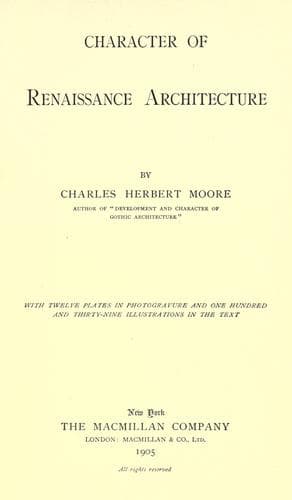
Character of Renaissance Architecture — John Shaqi
Character of Renaissance ArchitectureMoore, Charles Herbert
History
Character of Renaissance Architecture
Moore, Charles Herbert
Architecture, Renaissance
Among the many influences that were stirring the artistic minds of the
Renaissance there were two of chief importance, the Neo-pagan revival,
and the true intellectual life of the people which was independent of
the retrospective movement, and had been growing up through the Middle
Ages. The most sterling qualities of the artistic products of the
period are due to this intellectual life, and Florentine and Venetian
painting, the two most admirable phases of the supreme art of Italy,
are the finest expression of this. In other words, it was not the
revival of interest in ancient thought and feeling, nor the influence
of classic models, so much as the ripened development of the native
Italian genius itself, that produced what is most excellent in the Fine
Arts of the Renaissance. A consciously retrospective motive can hardly
be a vital force in artistic development, and the direct attempt, in so
far as such attempt was made, to shape the arts after classic models
was an unmixed evil. The native traditions and innate tendencies of
the Italian people were enough of themselves to give a strong classic
quality to their art. In architecture what of classic feeling was
natural to them needed only in the fifteenth century to be freed from
the elements which had been misappropriated from the mediæval art of
the North to allow it true expression in forms adapted to their needs.
In normal human progress each successive stage of development creates
its own appropriate forms; but peoples, like individuals, sometimes
pass through periods of partial aberration, and while genius may
still find scope enough, as in the Renaissance, to produce much that
is admirable, the noblest forms of art are not an outgrowth of such
conditions.
CHAPTER II
THE DOME OF FLORENCE
The great dome of the cathedral of Florence marks the beginning of
the Renaissance movement in architecture, though in its general form
and structural character it has no likeness to ancient domes, and has
few details drawn from the Roman classic source. It exhibits a wide
departure from any previous forms of dome construction, and is an
expression of the creative genius of a remarkably gifted man of great
independence, working under inspiration drawn in part from ancient
sources, in part from mediæval building traditions, and in still larger
part from the new motives that were beginning to animate the artistic
ambitions of the fifteenth century.
Public-domain text, read in full here on John Shaqi.
Reviews
Reviews
No reviews yet
Be the first to share your thoughts on this work.
Join the Discussion
Join the discussion
Sign in to leave a comment or review.
Sign InorCreate an account