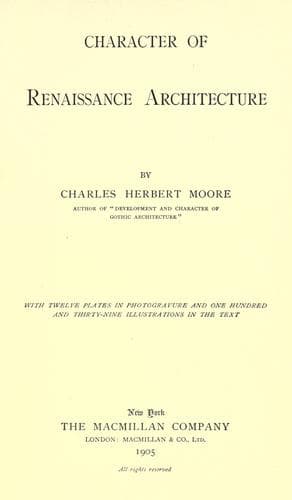
Character of Renaissance ArchitectureMoore, Charles Herbert
History
Character of Renaissance Architecture
Moore, Charles Herbert
Architecture, Renaissance
“Thanks to Mr. Russell Sturgis and a corps of competent assistants, we
now have in ‘A Dictionary of Architecture and Building: Biographical,
Historical, and Descriptive’ a much more valuable work than could have
been hoped for.... Several things are at once noticeable about this
work--the terseness and lucidity of its articles and definitions; the
extraordinary range of its subjects, from the arch of Septimius Severus
to modern apartment houses and tenements, and from St. Paul’s, London,
and the Doge’s palace in Venice, to a crib for hay such as one finds
in rural England, and a peasant’s hut in Asia Minor; the beauty of the
illustrations, and particularly the readiness with which they elucidate
the accompanying definitions and accounts; and the elaborate system of
cross-references, through which a glance at an article on any phase of
a given subject points the way at once to accounts of other related
terms and their uses.
“Perhaps the thoroughly modern spirit which dominates and inspires the
whole work is the feature that distinguishes this book most strongly
from the works in other languages which the seeker for definitions
hitherto has perforce consulted. The writers of these articles are
scholarly men, but they are something more than scholars. They are not
living in the past; they are doing their work in the world to-day,
and their point of view and their tone is a most satisfactory and
practical mixture of culture with the recognition of the needs of
the average American. An important feature of this work will be the
series of articles on the typical architecture of different countries.
Some of those in the present volume deal with the architectures of
Australia, Denmark, and England, while, to judge from cross-references,
the one in the final volume on the architecture of the United States
will be ambitious, elaborate, and inclusive. The connection of this
work with modern building is shown by the two long articles on the
‘Apartment House’ and ‘Electrical Appliances.’ Modern edifices are as
seriously considered as the ancient monuments described and pictured
by Viollet-le-Duc.... Now that it has appeared, this dictionary, many
of whose articles extend to the dimensions of those in encyclopædias,
becomes indispensable in its field.”--BOSTON HERALD.
THE MACMILLAN COMPANY, 64–66 Fifth Avenue, New York
FOOTNOTES:
[1] _Cronica di Giovanni Villani_, bk. 6, chap. 69.
[2] Cf. Introduction to Villari’s _Niccolo Machiavelli and his
Times_, London, 1878.
[3] Cf. Montalembert, _Les Moines d’Occident_, vol. 2, p. 488
_et seq._
[4] Cf. my _Development and Character of Gothic Architecture_, pp.
304–306.
[5] The Gothic of northern France of the twelfth and early thirteenth
centuries, the only true Gothic art, is here meant.
Public-domain text, read in full here on John Shaqi.
Reviews
Reviews
No reviews yet
Be the first to share your thoughts on this work.
Elsewhere in the archive
Join the Discussion
Join the discussion
Sign in to leave a comment or review.
Sign InorCreate an account