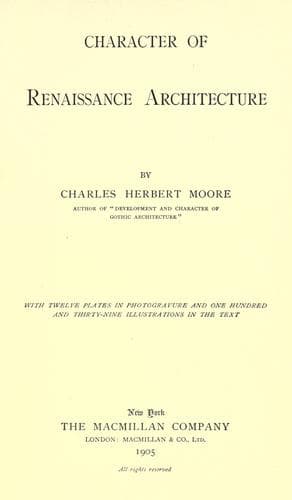
Character of Renaissance ArchitectureMoore, Charles Herbert
History
Character of Renaissance Architecture
Moore, Charles Herbert
Architecture, Renaissance
[6] The Viscount Delaborde, in his book _La Gravure en Italie avant
Marc-Antoine_, Paris, 1883, p. 32, remarks on this with admirable
discrimination as follows: “Certes, sous le pinceau de Botticelli,
de pareils sujets [subjects drawn from Classical Mythology] gardent
un caractère d’élégance tendre et de mélancolie presque analogue à
la physionomie des scènes où figurent l’Enfant-Dieu et la Madone. Il
y a loin de cette manière d’interpréter la Fable aux panégyriques
violemment ou galamment licencieux que les hôtes les plus mal famés
de l’Olympe obtiendront dans les siècles suivants; il y a loin des
gracieuses inventions de Botticelli aux _lascivie_ brutales de
Jules Romain et d’Augustin Carrache ou aux gamineries mythologiques
de Boucher et de ses pareils, et l’on a quelque peine aujourd’hui, en
face d’aussi chastes tableaux, à comprendre la véhémence des reproches
fulminés jadis par Savonarole.”
[7] The elevated domes of Arabian architecture are in many cases
constructed of wood and stucco. When of masonry they are, I believe,
either weighted within where the thrusts fall, or are bound with chains.
[8] I have not examined the dome of Pisa closely on the spot, but I
suppose it is bound with a chain, as we know was the custom at a later
time. Cf. Fontana, vol. 2, P. 363.
[9] There can be little doubt that the dome represented in this
fresco embodies the original project of Arnolfo, though this has been
questioned. Cf. Guasti, _Santa Maria del Fiore_, etc., Florence,
1887, pp. lx-lxi.
[10] This needs to be qualified. The thrusts of the dome being
continuous logically call for continuous abutment, as in the Pantheon,
but the intervals between the abutting members are so small that the
resistance is practically continuous.
[11] By its architectural character, I mean its character as a work of
art. By the term “architecture” we properly mean not building merely,
but the fine art of beautiful building.
[12] This has been based on the affirmations of Vasari, who states
that it was Brunelleschi’s purpose to “restore to light the good
[_i.e._ the ancient Roman] manner in architecture,” and that he
had “pondered on the difficulties” involved in vaulting the Pantheon.
Cf. _Le Opere di Giorgio Vasari_, Milanesi edition, Florence,
1880, vol. 2, p. 337.
Public-domain text, read in full here on John Shaqi.
Reviews
Reviews
No reviews yet
Be the first to share your thoughts on this work.
Elsewhere in the archive
Join the Discussion
Join the discussion
Sign in to leave a comment or review.
Sign InorCreate an account