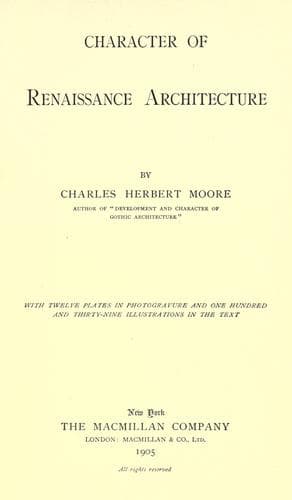
Character of Renaissance ArchitectureMoore, Charles Herbert
History
Character of Renaissance Architecture
Moore, Charles Herbert
Architecture, Renaissance
[20] It may be thought that this would condemn the use of metal clamps
in masonry, such as were inserted in the walls of the Parthenon, or
the wooden ties that were, in some cases, used in parts of Gothic
buildings. But there is a wide difference between such use of clamps
and ties, and the binding chains of the great domes of the Renaissance.
In the Greek and Gothic work the masonry forms are favourable to
stability independently of the clamps and ties. These were inserted
either for security against unusual dangers, as from earthquakes,
or for temporary security against rupture while the work was in
progress, before the interaction of the parts of the system was
fully established; but a dome without abutment violates the constant
conditions of stability.
[21] _Discrizione e Studj dell’Insigne Fabbrica di S. Maria del
Fiore_, Florence, 1733, p. xxi.
[22] _Memorie degli Architette_, etc., Florence, 1785, vol. 1, p.
190.
[23] Fontana, Nelli, Cecchini, and others.
[24] These ruptures were first observed in the year 1693 (Nelli, _op.
cit._, p. 13), and it was then advised by the architect Carlo
Fontana to add a new chain of iron. Nelli, however, argued that the
fissures had not arisen from thrust, but were due to a slight yielding
of the foundations, and he urged that no chain be added, but that a bit
of marble be dove-tailed into the vault across the opening, in order
that any further movement might be detected by the breaking of this
marble. For three years no further sign of disturbance was noticed,
but a slight earthquake in 1697 broke a portion of the masonry of the
outer face of the dome opposite the fissure across which the marble
had been placed. It appears, however, to have been concluded that
there was still no danger from thrust, and no new chain was inserted.
Cecchini (_Opinione intorno lo Stato della gran Cupola del Duomo di
Firenze_, published together with Nelli’s _Discorsi_, etc., p.
82) speaks of several cracks in both the inner and the outer shells of
the vault, and also in the supporting piers, even down to the ground.
But he agrees with Nelli in attributing these to movements of the
foundations from which he concludes that no further danger is to be
apprehended, and he affirms that the structure is entirely safe.
[25] Cf. Nelli, _op. cit._, p. 73.
[26] The thrusts of a hemispherical dome are, in some degree,
restrained by the binding of its continuous courses of masonry under
compression, but this is not enough for security, as experience has
shown; and in a polygonal dome, like Brunelleschi’s, there is no such
binding force, because there are no continuous circles of masonry.
Public-domain text, read in full here on John Shaqi.
Reviews
Reviews
No reviews yet
Be the first to share your thoughts on this work.
Elsewhere in the archive
Join the Discussion
Join the discussion
Sign in to leave a comment or review.
Sign InorCreate an account