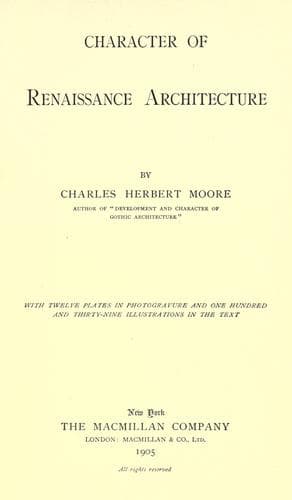
Character of Renaissance ArchitectureMoore, Charles Herbert
History
Character of Renaissance Architecture
Moore, Charles Herbert
Architecture, Renaissance
[89] I believe I am correct in this. Photographs seem to show it
clearly, but I have not verified this point in the monuments themselves.
[90] _Op. cit_., vol. 1, p. 240.
[91] _Le Vite_, etc., vol. 2, p. 433.
[92] Cf. p. 144.
[93] These ornamental features usually have, however, in Gothic art
some real structural function.
[94] _Op. cit._, bk. 3, p. 53.
[95] _Milizia_, vol. 1, p. 346.
[96] _Milizia_, vol. 1, pp. 346–347.
[97] _Ibid_., p. 351.
[98] “Sansovino lo sciolse con allungar il fregio quanto bastasse per
supplire al difetto di quella porzione di metopa: ed il problema, e ’l
ripiego sono un’inezia.”
[99] _Memorie_, etc., vol. 2, p. 34.
[100] _I Quattro Libri dell’ Architettura_, bk. 3, p. 41.
[101] “Non dubito che questa fabrica non possa esser comparata à gli
edifici antichi e annoverata tra le maggiori, e le più belle fabriche
che siano state fatte da gli antichi in quà, si per la grandezza, e per
gli ornamenti suoi, come anco per la materia, che è tutta di pietra
viva durisima, e sono state tutte le pietre commesse e legate insieme
con somma diligenza.” _Op. cit._, bk. 3, p. 41.
[102] They were grammatical, not in the sense of using the classic
orders with correctness,--this, as we have seen, they did not do,--but
in the sense of arranging their architectural details, such as they
were, on a basis of grammatical order.
[103] Sir William Chambers, in his _Treatise on the Decorative Part
of Civil Architecture_, London, 1791, p. 121, referring to this form
of opening, says, “It is an invention of Scamozzi’s.”
[104] Cf. Casati, _I Capi d’Arte di Bramante da Urbino nel
Milanese_, Milan, 1870, p. 24 _et seq._ That the design of San
Satiro was made by Bramante, Casati gives the evidence of a document
printed in the year 1500 by the deputies of the church in which it
is said, “ ... _Come vi si diede principio dopo l’anno 1470 con
disegno del celebre Bramante_.” And he finds further confirmation of
Bramante’s authorship in a commentary on Vitruvius by Cesare Cesariano,
printed in Como in 1521, where this author states that the church
and sacristy of San Satiro were designed by his preceptor, Donato of
Urbino, called Bramante.
[105] Salient ribs of stucco are carried up in the angles of the dome
of the sacristy as they are in the vaulting of the apses of Todi.
[106] Cf. Casati, _op. cit._, p. 44.
[107] Cf., p. 134, the window sometimes called that of Scamozzi.
[108] _Op. cit._, vol. 2, p. 434.
[109] Melani, _Architettura Italiana_, vol. 2, p. 154.
[110] Cf. _Architettura Italiana_, by Alfredo Melani, Milan, 1887,
vol. 2, p. 157.
[111] Coin of Metapontum.
[112] Vitruvius, bk. 7, chap. 5, refers with disapproval to the
tasteless and meaningless monstrosities embodied in the ornamental art
of his time, and the remains of Roman reliefs offer many examples of
such design.
Public-domain text, read in full here on John Shaqi.
Reviews
Reviews
No reviews yet
Be the first to share your thoughts on this work.
Elsewhere in the archive
Join the Discussion
Join the discussion
Sign in to leave a comment or review.
Sign InorCreate an account