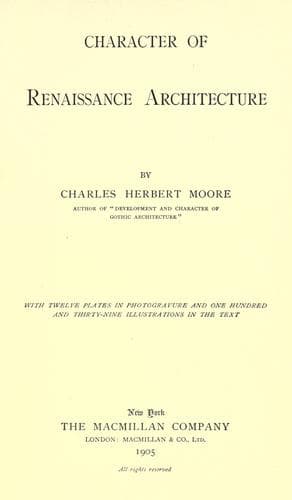
Character of Renaissance ArchitectureMoore, Charles Herbert
History
Character of Renaissance Architecture
Moore, Charles Herbert
Architecture, Renaissance
[113] The theory respecting the use of artificial elements in
architectural ornamentation developed by Ruskin in his well-known
chapter entitled, “The Lamp of Beauty,” in the _Seven Lamps of
Architecture_, is, I believe, entirely right in principle, though
the author is arbitrary in some of his conclusions and overemphatic in
some of his statements.
[114] The most authoritative French writers are misleading in affirming
that no radical departure from their best building traditions was
made by the French architects of the Renaissance. Thus Viollet le Duc
(Dict., vol. 3, _s. v._ _Château_, p. 174) says of these architects,
“Toujours fidèles a leurs anciens principes, ils ne sacrifièrent pas la
raison et le bon sens.” But while affirming this, these same writers
sometimes make admissions which so materially qualify the affirmation
as to deprive it of its truth; thus the same author, remarking on
the changes that were making in the character of the château, adds
(p. 185), “Nous accordons que la tentative était absurde; mais la
renaissance française est, à son début, dans les lettres, les sciences
ou les arts, pleine de ces hésitations.”
[115] Martin, _Hist. de France_, vol. 7, pp. 378–382.
[116] Cf. Viollet le Duc, _s. v._ _Château_, p. 190.
[117] I use Willis’s term, “continuous impost,” for an impost in which
the jambs pass into the arch without the interposition of a capital,
and without change of profiling.
[118] Du Cerceau’s plate (_Les Plus Excellents Bastiments de
France_, vol. 2, plate 4) is incorrect, like most of his other
plates, in giving the semicircular form to the openings of this façade.
[119] _Reigle Géneralle de Architecture_, etc., Paris, 1568.
[120] Said by Palustre, _L’Architecture de la Renaissance_, p.
176, to have been “servilement imité du temple de Jupiter Stator.”
[121] These lower arches are concealed from view on the external
façades by a basement wall.
[122] Adolphe Berty, _Les Grands Architectes Français de la
Renaissance_, Paris, 1860, p. 70.
[123] Milizia, _Memorie_, vol. 1, p. 404.
[124] Berty, _op. cit._, p. 71.
[125] _Les Plus Excellents Bastiments de France_, plate 69.
[126] The lines of this poem which relate to Lescot are quoted by M.
Berty in _op. cit._, pp. 66–68.
[127] _Regole Generale di Architettura di Sebastiano Serlio._
[128] _Op. cit._, plate 2.
Public-domain text, read in full here on John Shaqi.
Reviews
Reviews
No reviews yet
Be the first to share your thoughts on this work.
Elsewhere in the archive
Join the Discussion
Join the discussion
Sign in to leave a comment or review.
Sign InorCreate an account