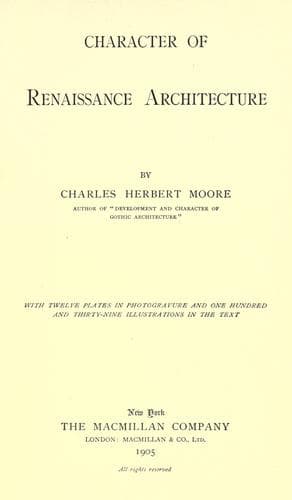
Character of Renaissance ArchitectureMoore, Charles Herbert
History
Character of Renaissance Architecture
Moore, Charles Herbert
Architecture, Renaissance
Recent writers have ignored the condition of this monument. They do
not appear to be aware of it; and although it has been fully set
forth, and discussed at great length by the earlier Italian writers,
few of them have found the true cause in its flagrant violation of the
fundamental laws of stability. They attributed the alarming progress
of disintegration, as we have seen, to accidents and circumstances
of various kinds; and have sought to shift the responsibility to the
shoulders of Bramante. They have affirmed that he did not take enough
care to make his foundations secure. There appears to be some justice
in this, though since his work was strengthened by his immediate
successors[63] the ruptures in the dome cannot, according to the
mathematicians, be attributed to this. The remarks of the old writers
on Bramante must, I think, be taken with some allowance. Their bias
against him is very marked. Thus Poleni quotes Condivi, a disciple
of Michael Angelo, as saying, “Bramante being, as every one knows,
given to every kind of pleasure, and a great spendthrift, not even the
provision given by the Pope, however much it was, sufficed him, and
seeking to expedite his work, he made the walls of bad materials, and
of insufficient size and strength.”[64]
A great deal has been said of the beauty of St. Peter’s dome. It
has been held up as a model of architectural elegance by countless
writers from Vasari down. But no abstract beauty, no impressiveness
as a commanding feature in the general view of the ancient city
that it may have, can make amends for such structural defects. Its
beauty has, however, I think, been exaggerated. Its lack of visible
organic connection with the substructure makes it inferior in effect
to the dome of Florence, where the structural lines of the edifice,
from the ground upward, give a degree of organic unity, and the
buttressed half-domed apses, grouped in happy subordination about the
base of the drum, prepare the eye to appreciate the majesty of the
soaring cupola as it rises over them. The dome of St. Peter’s has
not the beauty of logical composition. Beauty in architecture may, I
think, be almost defined as the artistic coördination of structural
parts. As in any natural organic form, a well-designed building
has a consistent internal anatomy, and its external character is a
consequence and expression of this. The dome of St. Peter’s violates
the true principles of organic composition, and this I believe to be
incompatible with the highest architectural beauty.
CHAPTER V
CHURCH ARCHITECTURE OF THE ROMAN RENAISSANCE
Public-domain text, read in full here on John Shaqi.
Reviews
Reviews
No reviews yet
Be the first to share your thoughts on this work.
Join the Discussion
Join the discussion
Sign in to leave a comment or review.
Sign InorCreate an account