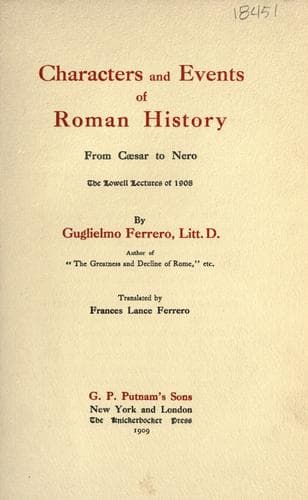
Characters and events of Roman HistoryFerrero, Guglielmo
History
Characters and events of Roman History
Ferrero, Guglielmo
Rome -- History -- Julio-Claudians, 30 B.C.-68 A.D.
The imperial bureaucracy that was formed mainly in the second century
was another effect of this enlargement of the middle classes. In the
second century there came into vogue many humanitarian ideas, which
have a certain resemblance to modern ones. There increased solicitude
for the general well-being, for order, for justice, and this augmented
the number of functionaries charged with insuring universal felicity
by administrative means. The movement was supported by intellectual
men of the middle classes, especially by jurists, who sought to put
their studies to profit, getting from the government employments in
which they might make use, well or ill, of their somewhat artificial
aptitudes. If the aristocratic idea, personified by Augustus
and Tiberius, delayed, it could not stop, the invasion of these
bureaucratic locusts; the government showed itself constantly weaker
with the intellectual classes. Little by little the whole Empire
was bureaucratised; founded by an aristocracy exclusively Roman in
statesmen and soldiers, it was finally governed by a cosmopolitan
bureaucracy of men of brains: orators, _litterati_, lawyers.
Therefore, to my thinking, they are wrong who believe that the
imperial bureaucracy created the unity of the Empire; whereas, the
formation of the imperial bureaucracy was one of the consequences of
that natural unification, the chief reason for which should be sought
in the great economic movement. The economic unification was first
and was entire; then came the political unity, made by the imperial
bureaucracy, which was less complete than the unifying of material
interests.
After the material unity, after the political, there should have been
formed the moral and intellectual; but at this point, the forces of
Rome gave way. Rome had gathered under its sceptre too many races,
too many kinds of culture, religions too diverse; its spirit was too
exclusively political, administrative, and judicial; it could not
therefore conciliate the ideas, assimilate the customs, weld the
sentiments, unify the religions, by its laws and decrees. To this
end was necessary the power of ideas, of doctrines, of beliefs that
officials of administration could neither create nor propagate. The
work was to be accomplished outside of, and in part against, the
government. It is the work of Christianity.
Public-domain text, read in full here on John Shaqi.
Reviews
Reviews
No reviews yet
Be the first to share your thoughts on this work.
Elsewhere in the archive
Join the Discussion
Join the discussion
Sign in to leave a comment or review.
Sign InorCreate an account