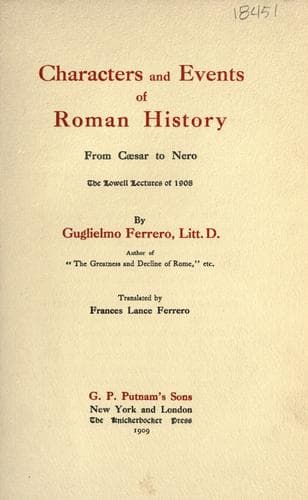
Characters and events of Roman HistoryFerrero, Guglielmo
History
Characters and events of Roman History
Ferrero, Guglielmo
Rome -- History -- Julio-Claudians, 30 B.C.-68 A.D.
Many have asked me how I shall consider Christianity in the sequence
of my work. In brief, I may say that I shall follow a different method
from that which its historians have taken up to this time: they have
studied especially how there was formed that part of Christianity
which yet lives and is the soul of it, namely, the religious doctrine.
On this account, they generally separate its history from the history
of the Empire, making of it the principal argument, considering the
history of Roman society as subordinate to it and therefore only an
appendix. I propose to reverse the study, taking Christianity as a
chapter, important but separate, in the history of the Empire. If
for three centuries Christianity has been gradually returning to its
origin, that is, becoming purely a religion and a moral teaching,
for some centuries in the ancient world it was a thing much more
complicated; a government and an administration that willed not only
to regulate the relations between man and God, but to govern the
intellectual, social, moral, political, and economic life of the
people! The historian ought to explain how this new Empire--for it was
indeed a new Empire--was formed in Rome and upon its ruins: this is a
problem much more intricate than at first appears.
It has been said and often repeated that the Church was in the Middle
Ages in Europe the continuation of the Roman Empire, that the Pope is
yet the real successor of the Emperor in Rome. In fact he carries one
of the Emperor's titles, _Pontifex maximus_. The observation is just,
but it should not make us forget that the Christian Empire, so to call
it, and the Roman Empire, were between themselves as radically
opposed as two forces that created the one and the other; politics and
intellectuality. The diplomatists, the generals, the legislators of
Rome created by political means, by wars, treaties, laws, a grand
economic and political unity, which they consolidated, quite giving
up the formation of a large intellectual and moral unity. The
intellectual men, who formed the most powerful nucleus of the Church
after the fourth century, took up again the Roman idea of unity and of
empire; but they transferred it from matter to mind, from the concrete
world of economic and political interests, to the world of ideas
and beliefs. They tried to re-do, by pen and word, the work of the
Scipios, of Lucullus, and of Cæsar, to conquer the world, not indeed
invading it with armies, but spreading a new faith, creating a new
morality, a new metaphysics which must gather up within themselves
the intellectual activities of Græco-Latin culture, from history to
science, from law to philosophy.
Public-domain text, read in full here on John Shaqi.
Reviews
Reviews
No reviews yet
Be the first to share your thoughts on this work.
Elsewhere in the archive
Join the Discussion
Join the discussion
Sign in to leave a comment or review.
Sign InorCreate an account