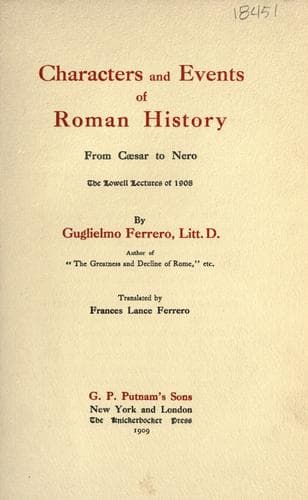
Characters and events of Roman HistoryFerrero, Guglielmo
History
Characters and events of Roman History
Ferrero, Guglielmo
Rome -- History -- Julio-Claudians, 30 B.C.-68 A.D.
The Church of the Middle Ages was therefore the most splendid edifice
that the intellectual classes have so far created. The power of this
empire of men of letters increased, as little by little the other
empire, that of the generals and diplomats, declined. Christianity saw
with indifference the Roman Empire decay; indeed, when it could,
it helped on the disintegration and was one of the causes of that
political and economic pulverising which everywhere succeeded the
great Roman unity. Political and economic unity on the one hand,
moral and intellectual on the other, seem in the history of European
civilisation things opposite and irreconcilable; when one is formed,
the other is undone. As the Roman Empire had found in intellectual
and moral disunion a means of preserving more easily the economic and
political unity, the Church broke to pieces the political and economic
unity of the ancient world to make, and for a long time preserve, its
own moral and intellectual oneness.
I shall make an effort, above all, to explain the origin, the
development, and the consequences of this contradiction, because I
believe that explaining this clears one of the weightiest and most
important points in all the history of our civilisation; in truth,
this contradiction seems to be the immortal soul of it. For instance:
in time, Augustus is twenty centuries away from us, but mentally
and morally he is, instead, much nearer, because for the last four
centuries Europe has been returning to Rome--that is, striving to
remake a great political and economic unity at the expense of the
intellectual and moral. In this fact particularly, lies the immense
historic importance of what is called the classic renaissance. It
indicates the beginning of an historic reversion that corresponds
in the opposite direction to what occurred in the third and fourth
centuries of the Christian era. The classic renaissance freed anew
the scientific spirit of the ancients from mediæval metaphysics and
therefore created the sciences; rediscovered some basic political
and juridical ideas of the ancient world, among them that of the
indivisibility of the State, which destroyed the foundations of
feudalism and of all the political orders of the Middle Ages; and gave
a great impetus to the struggle against the political domination of
the Church and toward the formation of the great states. France and
England have been in the lead, and for two centuries Europe has
been wearying itself imitating them. After the movement of political
unification followed the economic. Look about you: what do you see?
A world that looks more like the Roman Empire than it does the Middle
Ages; it is a world of great states whose dominating classes have
almost all the essential ideas of Græco-Latin civilisation; each,
seeking to better its own conditions, is forced to establish between
itself and the others the strictest economic relations and to bind
Public-domain text, read in full here on John Shaqi.
Reviews
Reviews
No reviews yet
Be the first to share your thoughts on this work.
Elsewhere in the archive
Join the Discussion
Join the discussion
Sign in to leave a comment or review.
Sign InorCreate an account