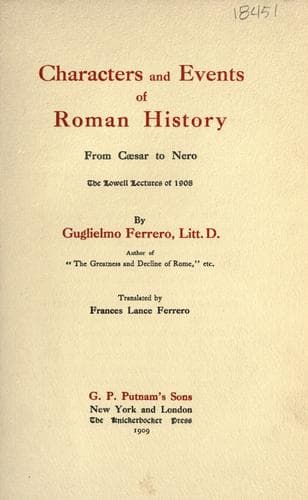
Characters and events of Roman HistoryFerrero, Guglielmo
History
Characters and events of Roman History
Ferrero, Guglielmo
Rome -- History -- Julio-Claudians, 30 B.C.-68 A.D.
believe that the history I have written is more like the truth than
those preceding it, but I do not consider myself on that account
a wonder-worker. I know I have been able to correct many preceding
errors, because I was the first to look attentively when the moment to
see and understand arrived.
Roman History in Modern Education.
When I announced my intention to write a new history of Rome, many
people manifested a sense of astonishment similar to what they would
have felt had I said that I meant to retire to a monastery. Was it to
be believed that the hurrying modern age, which bends all its energies
toward the future, would find time to look back, even for a moment, at
that past so far away? That my attempt was rash was the common
opinion not only of friends and critics, but also of publishers, who
everywhere at first showed themselves skeptical and hesitating. They
all said that the public was quite out of touch with Roman affairs. On
the contrary, facts have demonstrated that also in this age, in aspect
so eager for things modern, people of culture are willing to give
attention to the events and personages of ancient Rome.
The thing appears strange and bizarre, as is natural, to those who had
not considered it possible; consequently, few have seen how simple
and clear is its explanation. To those who showed surprise that the
history of Rome could become fashionable in Paris salons, I have
always replied: My history has had its fortune because it was the
history of Rome. Written with the same method and in the same style,
a history of Venice, or Florence, or England, would not have had the
same lot. One must not forget that the story of Rome occupies in the
intellectual world a privileged place. Not only is it studied in all
the schools of the civilised world; not only do nearly all states
spend money to bring to light all the documentary evidence that
the earth still conceals; but while all other histories are studied
fitfully, that of Rome is, so to speak, remade every fifty years,
and whoever arrives at the right time to do the making can gain a
reputation broader than that given to most historians.
There is, so to speak, in the history of Rome an eternal youth,
and for the mind in what is commonly called European-American
civilisation, it holds a peculiar attraction. From what deep sources
springs this perennial youth? In what consists this particular force
of attraction and renewal? It seems to me that the chief reason
for the eternal fascination of the history of Rome is this, that it
includes, as in a miniature drawn with simple lines, well defined,
all the essential phenomena of social life; so that every age is
able there to find its own image, its gravest problems, its intensest
passions, its most pressing interests, its keenest struggles;
therefore Roman history is forever modern, because every new age has
only to choose that part which most resembles it, to find its own
self.
Public-domain text, read in full here on John Shaqi.
Reviews
Reviews
No reviews yet
Be the first to share your thoughts on this work.
Elsewhere in the archive
Join the Discussion
Join the discussion
Sign in to leave a comment or review.
Sign InorCreate an account