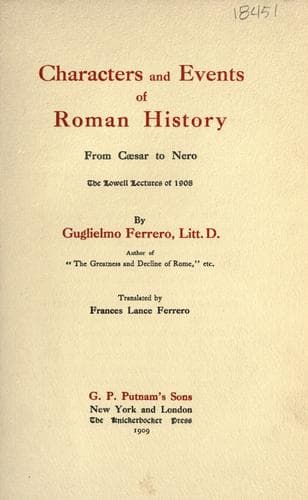
Characters and events of Roman HistoryFerrero, Guglielmo
History
Characters and events of Roman History
Ferrero, Guglielmo
Rome -- History -- Julio-Claudians, 30 B.C.-68 A.D.
In the intellectual history of the nineteenth century this leading
phenomenon of our culture is clearly evident. If any one asked me why,
during the past century, Roman history has proved so interesting, I
should not hesitate to reply, "Because Europeans and Americans
find, there more than elsewhere what has been the greatest political
upheaval of the hundred years that followed the French Revolution--the
struggle between monarchy and republic." From the fervid admiration
for the Roman Republic which animated the men of the French Revolution
to the unmeasured Cæsarian apologies of Duruy and of Mommsen, from
the ardent cult of Brutus to the detailed studies on the Roman
administration of the first two centuries, all historians have studied
and regarded Roman history mainly from the point of view of the
struggle between the two principles that yet to-day rend in incurable
discord the mind of old Europe and from which you have emerged
fortunate! You are free, in a new world; you have ended the combat
between the Latin principle of the impersonal state and the Oriental
principle of the dynastic state; between the state conceived as the
thing of all, belonging to every one and therefore of no one, and the
state personified in a family of an origin higher and nobler than
the common in which all authority derives from some hero-founder by
a mysterious virtue unaccountable to reason and human philosophy; you
have done with the conflict between the human state, simple, without
pomp, without dramatic symbols--the republic as we men of the
twentieth century understand it, and as you Americans conceive and
practise it--and the monarchy of divine right, vainglorious, full of
ceremonies and etiquette, despotic in internal constitution, which
still exists in Europe under more or less spurious forms. Now it is
easy to explain how, in an age in which the contest between these two
conceptions and these two forms of the State was so warm, the history
of Rome should so stir the mind.
In no other history do these two political forms meet each other in a
more irreconcilable opposition of characters in extreme. The Republic,
as Rome had founded it, was so impersonal that, in contrast with
modern more democratic republics, it had not even a fixed
bureaucracy, and all the public functions were exercised by
elective magistrates--even the executive--from public works to the
police-system. In the ancient monarchy which the Orient had created,
the dynastic principle was so strong that the State was considered
by inherent right the personal property of the sovereign, who might
expand it, contract it, divide it among his sons and relatives,
bequeathing his kingdom and his subjects as a land-owner disposes of
his estate and his cattle. Furthermore, although to-day the sovereigns
of Europe are pleased to treat quite familiarly with the good Lord,
the rulers in the Orient were held to be gods in their own right.
Public-domain text, read in full here on John Shaqi.
Reviews
Reviews
No reviews yet
Be the first to share your thoughts on this work.
Elsewhere in the archive
Join the Discussion
Join the discussion
Sign in to leave a comment or review.
Sign InorCreate an account