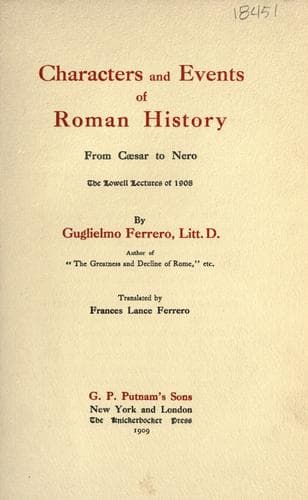
Characters and events of Roman HistoryFerrero, Guglielmo
History
Characters and events of Roman History
Ferrero, Guglielmo
Rome -- History -- Julio-Claudians, 30 B.C.-68 A.D.
Little by little, however, as the contest between republic and
monarchy gradually spent itself in Europe, in the last twenty-five
years of the nineteenth century, the interest for histories of Rome
conceived and written in this spirit, declined. The real reason why
Mommsen and Duruy are to-day so little read, why at the beginning of
the twentieth century Roman history no longer stirs enthusiasm through
their books is, above all, this: that readers no longer find in those
pages what corresponds directly to living reality. Therefore it was to
be believed that Roman history had grown old and out of date; whereas,
merely one of its perishing and deciduous forms had grown old, not the
soul of it, which is eternally living and young. So true is this, that
a writer had only to consider the old story from new points of view,
for Cæsar and Antony, Lucullus and Pompey, Augustus and the laws of
the year 18 B.C., to become subjects of fashionable conversation in
Parisian drawing-rooms, in the most refined intellectual centre of the
world.
It has never been difficult for me to realise that contemporary
Europe and America, the Europe and America of railroads, industries,
monstrous swift-growing cities, might find present in ancient Rome a
part of their own very souls, restless, turbulent, greedy. In the Rome
of the days of Cæsar, huge, agitated, seething with freedmen, slaves,
artisans come from everywhere, crowded with enormous tenement-houses,
run through from morning till night by a mad throng, eager for
amusements and distractions; in that Rome where there jostled together
an unnumbered population, uprooted from land, from family, from native
country, and where from the press of so many men there fermented all
the propelling energies of history and all the forces that destroy
morality and life--vice and intellectuality, the imperialistic policy,
deadly epidemics; in that changeable Rome, here splendid, there
squalid; now magnanimous, and now brutal; full of grandeurs, replete
with horrors; in that great city all the huge modern metropolises are
easily refound, Paris and New York, Buenos Ayres and London, Melbourne
and Berlin. Rome created the word that denotes this marvellous and
monstrous phenomenon, of history, the enormous city, the deceitful
source of life and death--_urbs_--_the city_. Whence it is not strange
that the countless _urbes_ which the grand economic progress of the
nineteenth century has caused to rise in every part of Europe and
America look to Rome as their eldest sister and their dean.
Public-domain text, read in full here on John Shaqi.
Reviews
Reviews
No reviews yet
Be the first to share your thoughts on this work.
Elsewhere in the archive
Join the Discussion
Join the discussion
Sign in to leave a comment or review.
Sign InorCreate an account