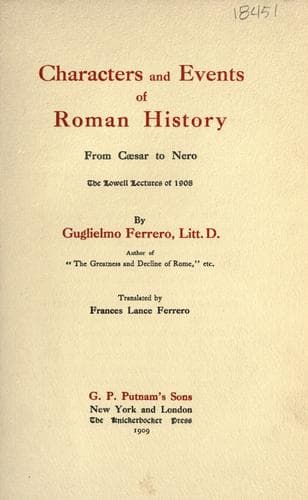
Characters and events of Roman HistoryFerrero, Guglielmo
History
Characters and events of Roman History
Ferrero, Guglielmo
Rome -- History -- Julio-Claudians, 30 B.C.-68 A.D.
Furthermore, into the history of Rome, the historic aristocracy of
Europe may look as into the mirror of their own destiny, as everywhere
they try to retain wealth and power, playing in the stock-exchange,
marrying the daughters of millionaire brewers, giving themselves
to commerce; a nobility that resorts, in the effort to preserve
its prestige over the middle classes, to the expedients of the most
reckless demagogy. Sulla, Lucullus, Pompey, Crassus, Antony, Cæsar,
exemplify in stupendous types the aristocracy that seeks to conserve
riches and power by audaciously employing the forces that menace its
own destruction.
Several critics of my work, particularly the French, have observed
that the policy of expansion made by Rome in the times of Cæsar, as
I have described it, resembles closely the craze for imperialism that
about ten years ago agitated England. It is true, for imperialism in
the time of Cæsar was what has existed for the last half century in
England--a means of which one part of the historic aristocracy availed
itself to keep power and renew decaying prestige, satisfying material
interests and flattering with intoxications of vanity the pride of
the masses. So, too, the contesting parties in France--the socialist,
which represents the labouring classes; the radical, which represents
the middle classes; the progressive and the monarchic, which represent
the wealthy burghers and the aristocracy--may discover some of their
passions, their doings, their invectives, in the political warfare
that troubled the age of Cæsar; in those scandals, those judicial
trials, in that furor of pamphlets and discourses. This is so true,
that in consequence my book met a singular fate in France; that of
being adopted by each party as an argument in its own favour. Drumont
made use of it to demonstrate to France what befalls a country when it
allows its national spirit to be corrupted by foreign influx, seeking
to persuade his fellow-citizens that the Jews in France do the same
work of intellectual and moral dissolution that the Orientals brought
about in Rome. Radical writers, like André Maurel, have sought
arguments in my work to combat the colonial and imperialistic policy.
The imperialists also, like Pinon, have looked for arguments to
support their stand-point. Was I not merely demonstrating that the
policy of expansion is a kind of universal and constant law, which
periodically actualises itself through the working of the same forces,
in the same ways?
Public-domain text, read in full here on John Shaqi.
Reviews
Reviews
No reviews yet
Be the first to share your thoughts on this work.
Elsewhere in the archive
Join the Discussion
Join the discussion
Sign in to leave a comment or review.
Sign InorCreate an account