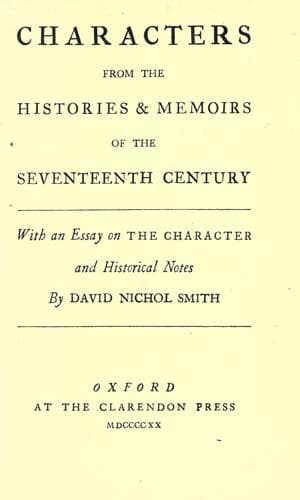
Characters from the Histories & Memoirs of the Seventeenth Century
History
Characters from the Histories & Memoirs of the Seventeenth Century
Great Britain -- Biography; Great Britain -- History -- Stuarts, 1603-1714
And this shall suffice to be said of that well intentioned, but
not truly considerative, great man, unles wee add this single thing
further, that he who looks upon him thro' those Canons, which in
Synod passed in his time, will find him a true Assertor of Religion,
Royalty, and Property; and that his grand designe was no other, than
that of our first Reformation; which was, that our Church might stand
upon such a foot of Primitive and Ecclesiastick authority, as suited
with God's word, and the best Interpreters of it, sound reason and
Primitive practice. And untill this Nation is blest with such a
spirit, it will lye in that darknes and confusion the Sects at this
time have flung it into.
27.
WILLIAM JUXON.
_Born 1582. President of St. John's College Oxford, 1621. Bishop of
London 1633-49. Lord Treasurer 1635-41. Archbishop of Canterbury 1660.
Died 1663_.
By SIR PHILIP WARWICK.
Having thus described one great Church-man, wee may the more fitly
make mention of another, because they were so intimate and bosome
Friends, and because this first is supposed to have introduced the
last into that eminent employment of Lord Treasurer. Had nature
mingled their tempers, and allayed the one by the prudence and
foresight of the other, or inspirited the other by the zeal and
activity of his Friend, nature had framed a better paist, than usually
she doth, when she is most exact in her work about mankind: sincerity
and integrity being eminent in them both. This reverend Prelate, Dr.
Juxon, then Bishop of London, was of a meek spirit, and of a solid and
steddy judgment; and having addicted his first studies to the Civil
Law, (from which he took his title of Doctor, tho' he afterwards took
on him the Ministry) this fitted him the more for Secular and State
affairs. His temper and prudence wrought so upon all men, that tho'
he had the two most invidious characters both in the Ecclesiasticall
and Civil State; one of a Bishop, the other of a Lord Treasurer: yet
neither drew envy on him; tho' the humor of the times tended to brand
all great men in employment. About the year 1634 the Lord Portland
dyed, and the Treasury was put into Commission; by which means the
true state thereof became distinctly to be known: and in the year
1635, this good and judicious man had the white staff put into his
hand: and tho' he found the revenue low and much anticipated, yet
withall meeting with times peaceable and regular, and his Master
enclined to be frugall, he held up the dignity and honor of his
Majestie's Houshold, and the splendor of the Court, and all publick
expences, and justice in all contracts; so as there were as few
dissatisfactions in his time, as perchance in any, and yet he cleared
off the anticipations on the revenue, and sett his Master beforehand.
The choice of this good man shewed, how remote it was from this King's
intentions, to be either tyrannicall or arbitrary; for so well he
demeaned himselfe thro' his whole seaven years employment, that
Public-domain text, read in full here on John Shaqi.
Reviews
Reviews
No reviews yet
Be the first to share your thoughts on this work.
Elsewhere in the archive
Join the Discussion
Join the discussion
Sign in to leave a comment or review.
Sign InorCreate an account