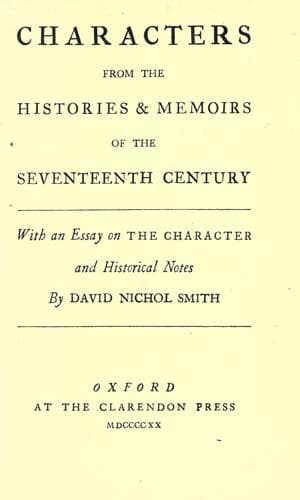
Characters from the Histories & Memoirs of the Seventeenth Century
History
Characters from the Histories & Memoirs of the Seventeenth Century
Great Britain -- Biography; Great Britain -- History -- Stuarts, 1603-1714
As this good Arch-Bishop I write of, had these great eminences, so he
may be acknowledged to have failed in those prudences, which belong
unto a great Minister of State, who like a wise Physician is to
consider times and seasons, as well as persons and diseases, and to
regard those complications, which usually are mixed in ill habits of
body, and to use more alterative than purgative Physick. For popular
bents and inclinations are cured more by a steddy than precipitate
hand or counsel; multitudes being to be drawn over from their errors,
rather by wayes they discerne not, than by those, which they are
likely to contest; whilst upon single persons and great men courses
of violence and authority may be exercised. But Ministers of State
unwillingly run this course, because they would have the honour of
perfecting the work they affect in their own time; and the multitude
of this good man's busines, and the promptnes of his nature, made
those ceremonies, which are necessary by great Persons to be paid unto
men in his station, to be unwelcome unto him, and so he discharged
himselfe of them, and thereby disobliged those persons, who thought
their quality, tho' not their busines, required a patient and
respectfull entertainment. This I reflect upon, because I heard from a
good hand, that the Marquiss of Argile making him an insidious visit,
and he, knowing he neither loved him nor the Church, entertaining him
not with that franknes he should have done, but plainly telling him,
he was at that time a little busy about the King's affairs, this great
Lord took it so much in indignation, and esteem'd it such a Lordly
Prelacy, that he declaimed against it, and became (if possible) more
enemy both to him and the Church, than he was before. The rectitude of
his nature therefore made him not a fitt instrument to struggle with
the obliquity of those times; and he had this infirmity likewise, that
he beleived those forward instruments, which he employed, followed the
zeal of their own natures, when they did but observe that of his: for
as soon as difficulty or danger appeared, his petty instruments shrunk
to nothing, and shewed, from whom they borrowed their heat.
He weighed not well his Master's condition; for he saw him circled
in by too many powerfull Scots, who mis-affected the Church, and had
joyned with them too many English Counsellors and Courtiers, who were
of the same leaven. If he had perceived an universall concurrence in
his own Clergy, who were esteemed Canonicall men, his attempts might
have seem'd more probable, than otherwise it could: but for him
to think by a purgative Physick to evacuate all those cold slimy
humors, which thus overflowed the body, was ill judged; for the good
affections of the Prince, back'd only by a naked or paper-authority,
sooner begets contumacy, than complyance in dissaffected Subjects....
Public-domain text, read in full here on John Shaqi.
Reviews
Reviews
No reviews yet
Be the first to share your thoughts on this work.
Elsewhere in the archive
Join the Discussion
Join the discussion
Sign in to leave a comment or review.
Sign InorCreate an account