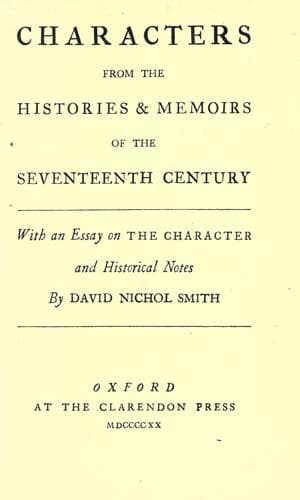
Characters from the Histories & Memoirs of the Seventeenth Century
History
Characters from the Histories & Memoirs of the Seventeenth Century
Great Britain -- Biography; Great Britain -- History -- Stuarts, 1603-1714
it was necessary, and he was set to it, he would stay as long as his
Ministers had work for him. The ruine of his reign, and of all his
affairs, was occasioned chiefly by his delivering himself up at his
first coming over to a mad range of pleasure.
64.
By BURNET.
Thus lived and died King _Charles_ the second. He was the greatest
instance in history of the various revolutions of which any one man
seemed capable. He was bred up, the first twelve years of his life,
with the splendor that became the heir of so great a Crown. After
that he past thro' eighteen years in great inequalities, unhappy in
the war, in the loss of his Father, and of the Crown of _England_.
_Scotland_ did not only receive him, tho' upon terms hard of
digestion, but made an attempt upon _England_ for him, tho' a feeble
one. He lost the battle of _Worcester_ with too much indifference:
And then he shewed more care of his person, than became one who had so
much at stake. He wandered about _England_ for ten weeks after that,
hiding from place to place. But, under all the apprehensions he had
then upon him, he shewed a temper so careless, and so much turned
to levity, that he was then diverting himself with little houshold
sports, in as unconcerned a manner, as if he had made no loss, and had
been in no danger at all. He got at last out of _England_. But he had
been obliged to so many, who had been faithful to him, and careful of
him, that he seemed afterwards to resolve to make an equal return to
them all: And finding it not easy to reward them all as they deserved,
he forgot them all alike. Most Princes seem to have this pretty deep
in them; and to think that they ought never to remember past services,
but that their acceptance of them is a full reward. He, of all in our
age, exerted this piece of prerogative in the amplest manner: For he
never seemed to charge his memory, or to trouble his thoughts, with
the sense of any of the services that had been done him. While he
was abroad at _Paris_, _Colen_, or _Brussells_, he never seemed to
lay any thing to heart. He pursued all his diversions, and irregular
pleasures, in a free carrier; and seemed to be as serene under the
loss of a Crown, as the greatest Philosopher could have been. Nor did
he willingly hearken to any of those projects, with which he often
complained that his Chancellor persecuted him. That in which he seemed
most concerned was, to find money for supporting his expence. And it
was often said, that, if _Cromwell_ would have compounded the matter,
and have given him a good round pension, that he might have been
induced to resign his title to him. During his exile he delivered
himself so entirely to his pleasures, that he became incapable of
application. He spent little of his time in reading or study, and
yet less in thinking. And, in the state his affairs were then in, he
accustomed himself to say to every person, and upon all occasions,
that which he thought would please most: So that words or promises
Public-domain text, read in full here on John Shaqi.
Reviews
Reviews
No reviews yet
Be the first to share your thoughts on this work.
Elsewhere in the archive
Join the Discussion
Join the discussion
Sign in to leave a comment or review.
Sign InorCreate an account