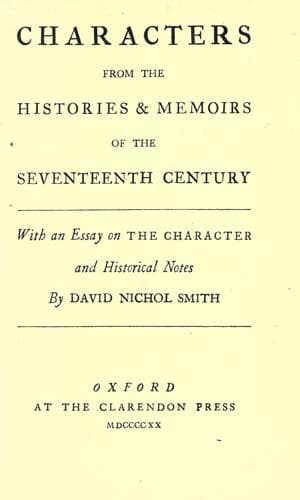
Characters from the Histories & Memoirs of the Seventeenth Century
History
Characters from the Histories & Memoirs of the Seventeenth Century
Great Britain -- Biography; Great Britain -- History -- Stuarts, 1603-1714
went very easily from him. And he had so ill an opinion of mankind,
that he thought the great art of living and governing was, to manage
all things and all persons with a depth of craft and dissimulation.
And in that few men in the world could put on the appearances of
sincerity better than he could: Under which so much artifice was
usually hid, that in conclusion he could deceive none, for all were
become mistrustful of him. He had great vices, but scarce any vertues
to correct them: He had in him some vices that were less hurtful,
which corrected his more hurtful ones. He was during the active part
of life given up to sloth and lewdness to such a degree, that he hated
business, and could not bear the engaging in any thing that gave him
much trouble, or put him under any constraint. And, tho' he desired to
become absolute, and to overturn both our religion and our laws, yet
he would neither run the risque, nor give himself the trouble, which
so great a design required. He had an appearance of gentleness in his
outward deportment: But he seemed to have no bowels nor tenderness in
his nature: And in the end of his life he became cruel. He was apt to
forgive all crimes, even blood it self: Yet he never forgave any thing
that was done against himself, after his first and general act of
indemnity, which was to be reckoned as done rather upon maxims of
state than inclinations of mercy. He delivered himself up to a most
enormous course of vice, without any sort of restraint, even from
the consideration of the nearest relations: The most studied
extravagancies that way seemed, to the very last, to be much delighted
in, and pursued by him. He had the art of making all people grow fond
of him at first, by a softness in his whole way of conversation, as he
was certainly the best bred man of the age. But when it appeared how
little could be built on his promise, they were cured of the fondness
that he was apt to raise in them. When he saw young men of quality,
who had something more than ordinary in them, he drew them about him,
and set himself to corrupt them both in religion and morality; in
which he proved so unhappily successful, that he left _England_ much
changed at his death from what he had found it at his Restoration. He
loved to talk over all the stories of his life to every new man that
came about him. His stay in _Scotland_, and the share he had in the
war of _Paris_, in carrying messages from the one side to the other,
were his common topicks. He went over these in a very graceful manner;
but so often, and so copiously, that all those who had been long
accustomed to them grew weary of them: And when he entred on those
stories they usually withdrew: So that he often began them in a full
audience, and before he had done there were not above four or five
left about him: Which drew a severe jest from _Wilmot_, Earl of
_Rochester_. He said, he wondred to see a man have so good a memory
Public-domain text, read in full here on John Shaqi.
Reviews
Reviews
No reviews yet
Be the first to share your thoughts on this work.
Elsewhere in the archive
Join the Discussion
Join the discussion
Sign in to leave a comment or review.
Sign InorCreate an account