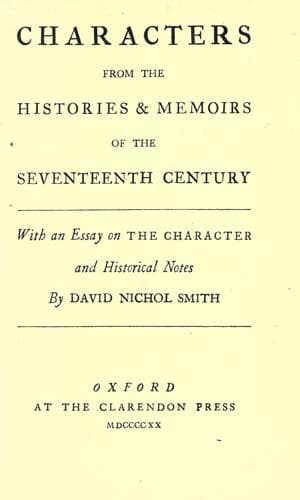
Characters from the Histories & Memoirs of the Seventeenth Century
History
Characters from the Histories & Memoirs of the Seventeenth Century
Great Britain -- Biography; Great Britain -- History -- Stuarts, 1603-1714
as to repeat the same story without losing the least circumstance, and
yet not remember that he had told it to the same persons the very day
before. This made him fond of strangers; for they hearkned to all
his often repeated stories, and went away as in a rapture at such an
uncommon condescension in a King.
His person and temper, his vices as well as his fortunes, resemble the
character that we have given us of _Tiberius_ so much, that it were
easy to draw the parallel between them. _Tiberius_'s banishment, and
his coming afterwards to reign, makes the comparison in that respect
come pretty near. His hating of business, and his love of pleasures;
his raising of favourites, and trusting them entirely; and his pulling
them down, and hating them excessively; his art of covering deep
designs, particularly of revenge, with an appearance of softness,
brings them so near a likeness, that I did not wonder much to observe
the resemblance of their face and person. At _Rome_ I saw one of the
last statues made for _Tiberius_, after he had lost his teeth. But,
bating the alteration which that made, it was so like King _Charles_,
that Prince _Borghese_, and _Signior Dominica_ to whom it belonged,
did agree with me in thinking that it looked like a statue made for
him.
65.
THE EARL OF CLARENDON.
_Edward Hyde, knighted 1643, created Baron Hyde 1660, Earl of
Clarendon 1661. Lord Chancellor 1658-1667._
_Born 1609. Died 1674._
By BURNET.
The Earl of _Clarendon_ was bred to the Law, and was like to grow
eminent in his profession when the wars began. He distinguished
himself so in the House of Commons, that he became considerable, and
was much trusted all the while the King was at _Oxford_. He stayed
beyond sea following the King's fortune till the Restoration; and was
now an absolute favourite, and the chief or the only Minister, but
with too magisterial a way. He was always pressing the King to mind
his affairs, but in vain. He was a good Chancellour, only a little too
rough, but very impartial in the administration of justice. He never
seemed to understand foreign affairs well: And yet he meddled too much
in them. He had too much levity in his wit, and did not always observe
the decorum of his post. He was high, and was apt to reject those
who addressed themselves to him with too much contempt. He had such a
regard to the King, that when places were disposed of, even otherwise
than as he advised, yet he would justify what the King did, and
disparage the pretensions of others, not without much scorn; which
created him many enemies. He was indefatigable in business, tho' the
gout did often disable him from waiting on the King: Yet, during his
credit, the King came constantly to him when he was laid up by it.
66.
THE EARL OF LAUDERDALE.
_John Maitland, second Earl, created Duke 1672, Secretary of State for
Scotland 1660-1680._
_Born 1616. Died 1682._
By CLARENDON.
Public-domain text, read in full here on John Shaqi.
Reviews
Reviews
No reviews yet
Be the first to share your thoughts on this work.
Elsewhere in the archive
Join the Discussion
Join the discussion
Sign in to leave a comment or review.
Sign InorCreate an account