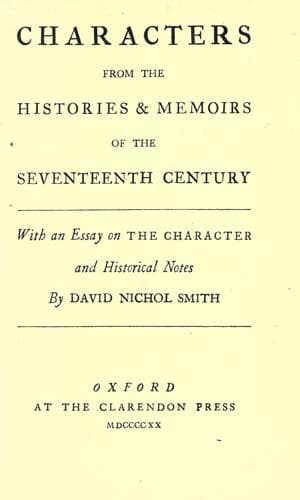
Characters from the Histories & Memoirs of the Seventeenth Century
History
Characters from the Histories & Memoirs of the Seventeenth Century
Great Britain -- Biography; Great Britain -- History -- Stuarts, 1603-1714
The original manuscripts, now also in the possession of the University
of which Clarendon's family were such generous benefactors, enable
us to fix the dates of composition. We know whether a part belongs
originally to the 'Manuscript History' or the 'Manuscript Life', or
whether it was pieced in later. More than this, Clarendon every now
and again inserts the month and the day on which he began or ended
a section. We can thus trace the stages by which his great work was
built up, and learn how his art developed. We can also judge how
closely the printed texts represent what Clarendon had written. The
old controversy on the authenticity of the first edition has long been
settled.[2] The original editors did their work faithfully according
to the editorial standards of their day; and they were well within the
latitude allowed them by the terms of Clarendon's instructions when
they occasionally omitted a passage, or when they exercised their
somewhat prim and cautious taste in altering and polishing phrases
that Clarendon had dashed down as quickly as his pen could move.[3]
Later editors have restored the omitted passages and scrupulously
reproduced Clarendon's own words. But no edition has yet reproduced
his spelling. In the characters printed in this volume the attempt
is made, for the first time it is believed, to represent the original
manuscripts accurately to the letter.[4]
On the defeat of the last Royalist army in Cornwall in February 1646
it was necessary to provide for the safety of Prince Charles, and
Clarendon, in these days Sir Edward Hyde, accompanied him when on the
night of March 2 he set sail for Scilly. They arrived in Scilly on
March 4, and there they remained till April 16, when the danger of
capture by the Parliamentary fleet compelled them to make good their
escape to Jersey. It is a remarkable testimony to the vigour of
Clarendon's mind that even in the midst of this crisis he should
have been able to begin his _History_. He began it in Scilly on March
18, 1646--the date is at the head of his manuscript; and once he
was settled in Jersey he immediately resumed it. But in writing his
_History_ he did not, in these days, think of himself only as an
historian. He was a trusted adviser of the defeated party, and he
planned his faithful narrative of what he knew so well not solely to
vindicate the character and conduct of the King, but also with the
immediate purpose of showing how the disasters had been brought out,
and, by implication, how further disaster might be avoided. The proof
of this is to be found not in the _History_ itself, where he seems
to have his eye only on 'posterity' and 'a better age', but in his
correspondence. In a letter written to Sir Edward Nicholas, the King's
secretary, on November 15, 1646, Clarendon spoke of his _History_ at
some length:
Public-domain text, read in full here on John Shaqi.
Reviews
Reviews
No reviews yet
Be the first to share your thoughts on this work.
Join the Discussion
Join the discussion
Sign in to leave a comment or review.
Sign InorCreate an account