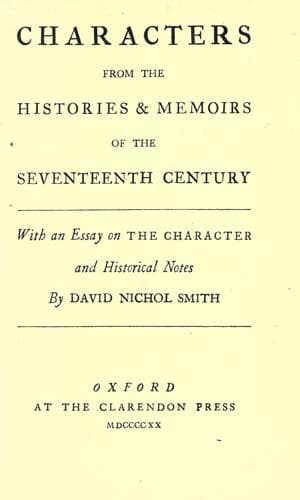
Characters from the Histories & Memoirs of the Seventeenth Century
History
Characters from the Histories & Memoirs of the Seventeenth Century
Great Britain -- Biography; Great Britain -- History -- Stuarts, 1603-1714
his whole deportment, which was ever grave and moderate. These have
been the greatest divines we have had these forty years: And may we
ever have a succession of such men to fill the room of those who have
already gone off the stage, and of those who, being now very old,
cannot hold their posts long. Of these I have writ the more fully,
because I knew them well, and have lived long in great friendship with
them; but most particularly with _Tillotson_ and _Lloyd_. And, as I
am sensible I owe a great deal of the consideration that has been had
for me to my being known to be their friend, so I have really learned
the best part of what I know from them. But I owed them much more
on the account of those excellent principles and notions, of which
they were in a particular manner communicative to me. This set of
men contributed more than can be well imagined to reform the way
of preaching; which among the divines of _England_ before them was
over-run with pedantry, a great mixture of quotations from fathers
and ancient writers, a long opening of a text with the concordance
of every word in it, and a giving all the different expositions with
the grounds of them, and the entring into some parts of controversy,
and all concluding in some, but very short, practical applications,
according to the subject or the occasion. This was both long and
heavy, when all was pye-balled, full of many sayings of different
languages. The common style of sermons was either very flat and low,
or swelled up with rhetorick to a false pitch of a wrong sublime. The
King had little or no literature, but true and good sense; and had got
a right notion of style; for he was in _France_ at a time when they
were much set on reforming their language. It soon appear'd that he
had a true taste. So this help'd to raise the value of these men,
when the King approved of the style their discourses generally ran
in; which was clear, plain, and short. They gave a short paraphrase
of their text, unless where great difficulties required a more copious
enlargement: But even then they cut off unnecessary shews of learning,
and applied themselves to the matter, in which they opened the nature
and reasons of things so fully, and with that simplicity, that their
hearers felt an instruction of another sort than had commonly been
observed before. So they became very much followed: And a set of these
men brought off the City in a great measure from the prejudices they
had formerly to the Church.
75.
JAMES II.
_Born 1633. Created Duke of York. Succeeded Charles II 1685. Fled to
France 1688. Died 1701._
By BURNET.
Public-domain text, read in full here on John Shaqi.
Reviews
Reviews
No reviews yet
Be the first to share your thoughts on this work.
Elsewhere in the archive
Join the Discussion
Join the discussion
Sign in to leave a comment or review.
Sign InorCreate an account