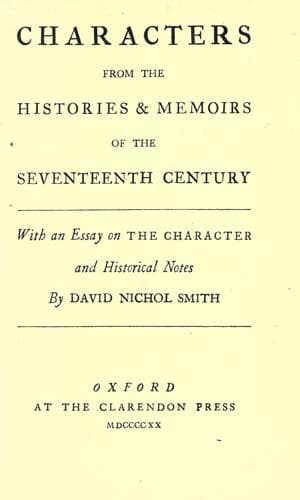
Characters from the Histories & Memoirs of the Seventeenth Century
History
Characters from the Histories & Memoirs of the Seventeenth Century
Great Britain -- Biography; Great Britain -- History -- Stuarts, 1603-1714
I will digress a little to give an account of the Duke's character,
whom I knew for some years so particularly, that I can say much
upon my own knowledge. He was very brave in his youth, and so much
magnified by Monsieur _Turenne_, that, till his marriage lessened him
he really clouded the King, and pass'd for the superior genius. He was
naturally candid and sincere, and a firm friend, till affairs and his
religion wore out all his first principles and inclinations. He had
a great desire to understand affairs: And in order to that he kept
a constant journal of all that pass'd, of which he shewed me a
great deal. The Duke of _Buckingham_ gave me once a short but severe
character of the two brothers. It was the more severe, because it
was-true: The King (he said) could see things if he would, and the
Duke would see things if he could. He had no true judgment, and
was soon determined by those whom he trusted: But he was obstinate
against all other advices. He was bred with high notions of the Kingly
authority, and laid it down for a maxim, that all who opposed the King
were rebels in their hearts. He was perpetually in one amour or other,
without being very nice in his choice: Upon which the King said once,
he believed his brother had his mistresses given him by his Priests
for penance. He gave me this account of his changing his religion:
When he escaped out of the hands of the Earl of _Northumberland_, who
had the charge of his education trusted to him by the Parliament, and
had used him with great respect, all due care was taken, as soon as
he got beyond sea, to form him to a strict adherence to the Church
of _England_: Among other things much was said of the authority of
the Church, and of the tradition from the Apostles in support of
Episcopacy: So that, when he came to observe that there was more
reason to submit to the Catholick Church than to one particular
Church, and that other traditions might be taken on her word, as
well as Episcopacy was received among us, he thought the step was not
great, but that it was very reasonable to go over to the Church of
_Rome_: And Doctor _Steward_ having taught him to believe a real but
unconceivable presence of _Christ_ in the Sacrament, he thought this
went more than half way to transubstantiation. He said, that a Nun's
advice to him to pray every day, that, if he was not in the right way,
God would set him right, did make a great impression on him. But he
never told me when or where he was reconciled. He suffered me to say a
great deal to him on all these heads. I shewed the difference between
submission and obedience in matters of order and indifferent things,
and an implicite submission from the belief of infallibility. I
also shewed him the difference between a speculation of a mode of
_Christ's_ presence, when it rested in an opinion, and an adoration
founded on it: Tho' the opinion of such a presence was wrong, there
was no great harm in that alone: But the adoration of an undue object
Public-domain text, read in full here on John Shaqi.
Reviews
Reviews
No reviews yet
Be the first to share your thoughts on this work.
Elsewhere in the archive
Join the Discussion
Join the discussion
Sign in to leave a comment or review.
Sign InorCreate an account