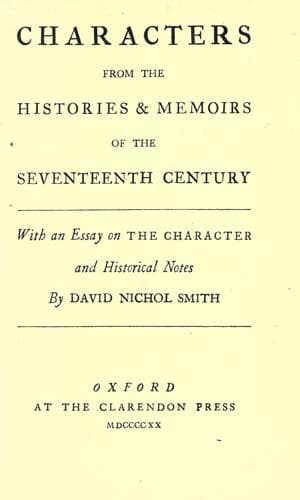
Characters from the Histories & Memoirs of the Seventeenth Century
History
Characters from the Histories & Memoirs of the Seventeenth Century
Great Britain -- Biography; Great Britain -- History -- Stuarts, 1603-1714
Arthur Wilson (1595-1652) was a gentleman-in-waiting to Robert
Devereux, third Earl of Essex, during James's reign, and was
afterwards in the service of Robert Rich, second Earl of Essex. The
_History_ was written towards the end of his life, and published the
year after his death. He was the author also of an autobiography,
_Observations of God's Providence in the Tract of my Life_ (first
printed in Francis Peck's _Desiderata Curiosa_, 1735, Lib. XII, pp.
6-34), and of three plays, _The Swisser_ (performed at Blackfriars,
1633, first printed in 1904, ed. Albert Feuillerat, from the MS.
in the British Museum), _The Corporall_ (performed, 1633, but not
extant), and _The Inconstant Lady_ (first printed in 1814, ed. Philip
Bliss, from the MS. in the Bodleian Library). The three plays were
entered in the Registers of the Stationers' Company, September 4,
1646, and September 9, 1653. But nothing he wrote appears to have been
published during his life.
Page 2, l. 24. _Peace begot Plenty_. An adaptation of the wellknown
saying which Puttenham in his _Arte of English Poesie_ (ed. Arber, p.
217) attributes to Jean de Meung. Puttenham gives it thus:
Peace makes plentie, plentie makes pride,
Pride breeds quarrell, and quarrell brings warre:
Warre brings spoile, and spoile pouertie,
Pouertie pacience, and pacience peace:
So peace brings warre, and warre brings peace.
It is found also in Italian and Latin. Allusions to it are frequent
in the seventeenth century. Compare the beginning of Swift's _Battle
of the Books_, and see the correspondence in _The Times Literary
Supplement_, February 17-March 30, 1916.
2.
The Court and Character of King James. Written and taken by Sir
A.W. being an eye, and eare witnesse. Qui nescit dissimulare, nescit
regnare. Published by Authority. London, MDCL.
'The Character of King James' forms a section by itself at the
conclusion of the volume, pp. 177-89. The volume was reprinted in
the following year, when there were added to it 'The Court of King
Charles' and 'Observations (instead of a Character) upon this King,
from his Childe-hood'. Both editions are carelessly printed. The
second, which corrects some of the errors of the first but introduces
others, has been used for the present text.
Weldon was clerk of the kitchen to James I and afterwards clerk of
the Green Cloth. He was knighted in 1617, and accompanied James to
Scotland in that year, but was dismissed from his place at court for
his satire on the Scots. He took the side of the parliament in the
Civil War. The dedication to Lady Elizabeth Sidley (first printed in
the second edition) states that the work 'treads too near the heeles
of truth, and these Times, to appear in publick'. According to Anthony
à Wood she had suppressed the manuscript, which was stolen from
her. Weldon had died before it was printed. The answer to it called
_Aulicus Coquinariæ_ describes it as 'Pretended to be penned by Sir
A.W. and published since his death, 1650'.
Public-domain text, read in full here on John Shaqi.
Reviews
Reviews
No reviews yet
Be the first to share your thoughts on this work.
Elsewhere in the archive
Join the Discussion
Join the discussion
Sign in to leave a comment or review.
Sign InorCreate an account