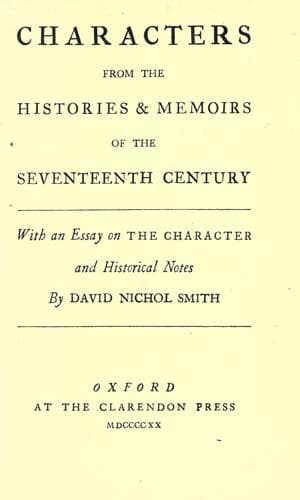
Characters from the Histories & Memoirs of the Seventeenth Century
History
Characters from the Histories & Memoirs of the Seventeenth Century
Great Britain -- Biography; Great Britain -- History -- Stuarts, 1603-1714
Other works of the same kind, though of inferior value, are Sir Edward
Peyton's _The Divine Catastrophe of The Kingly Family Of the House of
Stuarts_, 1652, and Francis Osborne's _Traditionall Memoyres on The
Raigne of King James_, 1658. They were printed together by Sir Walter
Scott in 1811 under the title _The Secret History of the Court of
James the First_, a collection which contains the historical material
employed in _The Fortunes of Nigel_.
Though carelessly written, and as carelessly printed, Weldon's
character of James is in parts remarkably vivid. It was reprinted by
itself in Morgan's _Pboenix Britannicus_, 1732, pp. 54-6; and it
was incorporated in the edition of Defoe's _Memoirs of a Cavalier_
published in 1792: see _The Retrospective Review_, 1821, vol. iii, pt.
ii, pp. 378-9.
There is a valuable article on Weldon's book as a whole in _The
Retrospective Review_, 1823, vol. vii, pt. I.
PAGE 4, l. 6. _before he was born_, probably an allusion to the murder
of Rizzio in Mary's presence.
l. 11. The syntax is faulty: delete 'and'?
On James's capacity for strong drinks, compare Roger Coke's _Detection
of the Court and State of England_ (1694), ed. 1719, vol. i, p. 78.
l. 27. _that foul poysoning busines_, the poisoning of Sir Thomas
Overbury, the great scandal of the reign. Robert Ker, or Carr, created
Viscount Rochester 1611 and Earl of Somerset 1613, had cast his eye
on the Countess of Essex, and, after a decree of nullity of marriage
with Essex had been procured, married her in December 1613. Overbury,
who had been Somerset's friend, opposed the projected marriage. On
a trumped up charge of disobedience to the king he was in April 1613
committed to the Tower, where he was slowly poisoned, and died in
September. Somerset and the Countess were both found guilty in 1616,
but ultimately pardoned; four of the accomplices were hanged. Weldon
deals with the scandal at some length in the main part of his work,
pp. 61 ff.
l. 30. _Mountgomery_, Philip Herbert, created Earl of Montgomery 1605,
succeeded his brother, William Herbert, as fourth Earl of Pembroke
in 1630 (see No. 7). To this 'most noble and incomparable paire
of brethren' Heminge and Condell dedicated the First Folio of
Shakespeare's plays, 1623. Montgomery's character is given by
Clarendon, _History_, ed. Macray, vol. i, pp. 74-5; and, as fourth
Earl of Pembroke, vol. ii, pp. 539-41.
Public-domain text, read in full here on John Shaqi.
Reviews
Reviews
No reviews yet
Be the first to share your thoughts on this work.
Elsewhere in the archive
Join the Discussion
Join the discussion
Sign in to leave a comment or review.
Sign InorCreate an account