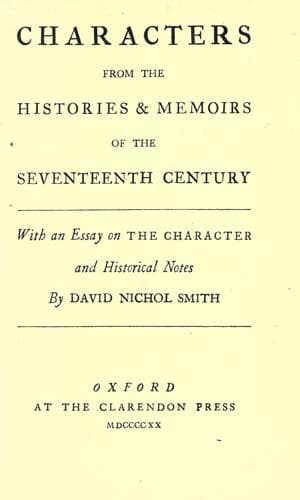
Characters from the Histories & Memoirs of the Seventeenth Century
History
Characters from the Histories & Memoirs of the Seventeenth Century
Great Britain -- Biography; Great Britain -- History -- Stuarts, 1603-1714
l. 18. _his Tuesday Sermons_, likewise explained by an earlier passage
in Weldon's book, pp. 8, 9: 'the chiefe of those secrets, was that
of _Gowries_ Conspiracy, though that Nation [the Scots] gave little
credit to the Story, but would speak sleightly and despitefully of
it, and those of the wisest of that Nation; yet there was a weekly
commemoration by the Tuesday Sermon, and an anniversary Feast, as
great as it was possible, for the Kings preservation, ever on the
fifth of August.' James attempted to force the Tuesday sermon on the
University of Oxford; it was to be preached by members of each college
in rotation. See Brodrick's _Memorials of Merton College_, 1885, p.
70.
Page 8, l. 1. _a very wise man_. Compare _The Fortunes of Nigel_,
chap. v: 'the character bestowed upon him by Sully--that he was
the wisest fool in Christendom'. Two volumes of the _Mémoires_ of
Maximilien de Béthune, Duc de Sully (1560-1641), appeared in 1638; the
others after 1650. There is much about James in the second volume, but
this description of him does not appear to be there.
ll. 10-12. _two Treasurers_, see p. 21, ll. 15-22: _three
Secretaries_, Sir Thomas Lake; Sir Robert Naunton; Sir George Calvert,
Baron Baltimore; Sir Edward Conway, Viscount Conway: _two Lord
Keepers_, Sir Francis Bacon; John Williams, Bishop of Lincoln (see
p. 18, l. 5): _two Admiralls_, Charles Howard of Effingham, Earl of
Nottingham; the Duke of Buckingham: _three Lord chief Justices_, Sir
Edward Coke; Henry Montagu, Earl of Manchester; James Ley, Earl of
Marlborough.
Weldon's statement is true of the year 1623; he might have said
'_three_ Treasurers' and '_four_ Secretaries'.
3.
Clarendon, MS. Life, pp. 7-9, 18-20; _History_, Bk. I, ed. 1702, vol.
i, pp. 9-11, 26-9; ed. Macray, vol. i, pp. 10-13, 38-43.
This is the first of the portraits in Clarendon's great gallery, and
it is drawn with great care. Clarendon was only a youth of twenty when
Buckingham was assassinated, and he had therefore not the personal
knowledge and contact to which the later portraits owe so much of
their value. But he had throughout all his life been interested in
the remarkable career of this 'very extraordinary person'. Sir Henry
Wotton's 'Observations by Way of Parallel' on the Earl of Essex
and Buckingham had suggested to him his first character study, 'The
Difference and Disparity' between them. (It is printed after the
'Parallel' in _Reliquiæ Wottonianæ_, and described in the third
edition, 1672, as 'written by the Earl of Clarendon in his younger
dayes'.) His two studies offer an interesting comparison. Many of the
ideas are the same, but there is a marked difference in the precision
of drawing and the ease of style. The character here reprinted was
written when Clarendon had mastered his art.
Page 11, l. 5. See p. 4, l. 27.
Page 13, l. 25. The passage here omitted deals with Buckingham's
unsuccessful journey to Spain with Prince Charles, and with his
assassination.
Public-domain text, read in full here on John Shaqi.
Reviews
Reviews
No reviews yet
Be the first to share your thoughts on this work.
Elsewhere in the archive
Join the Discussion
Join the discussion
Sign in to leave a comment or review.
Sign InorCreate an account