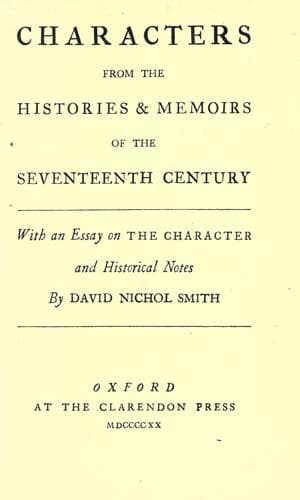
Characters from the Histories & Memoirs of the Seventeenth Century
History
Characters from the Histories & Memoirs of the Seventeenth Century
Great Britain -- Biography; Great Britain -- History -- Stuarts, 1603-1714
Page 16, l. 28. _touched upon before_, ed. Macray, vol. i, p. 38; here
omitted.
4.
Clarendon, MS. Life, pp. 27, 28; _History_, Bk. I, ed. 1702, vol. i,
pp. 36-8; ed. Macray, vol. i, pp. 56-9.
Page 18, l. 5. _the Bishopp of Lincolne_, John Williams (1582-1650),
afterwards Archbishop of York. He succeeded Bacon as Lord Keeper. He
is sketched in Wilson's _History of Great Britain_, pp. 196-7, and
Fuller's _Church-History of Britain_, 1655, Bk. XI, pp. 225-8. His
life by John Hacket, _Scrinia Reserata_, 1693, is notorious for the
'embellishments' of its style; a shorter life, based on Hacket's, was
an early work of Ambrose Philips.
l. 22. _the Earle of Portlande_, Sir Richard Weston: see No. 5.
l. 24. _Hambleton_, Clarendon's usual spelling of 'Hamilton'.
5.
Clarendon, MS. Life, pp. 28-32; _History_, Bk. I, ed. 1702, vol. i,
pp. 31-43; ed. Macray, vol. i, pp. 59-67.
Another and more favourable character of Weston is the matter of an
undated letter which Sir Henry Wotton sent to him as 'a strange New
years Gift' about 1635. 'In short, it is only an Image of your Self,
drawn by memory from such discourse as I have taken up here and
there of your Lordship, among the most intelligent and unmalignant
men; which to pourtrait before you I thought no servile office, but
ingenuous and real'. See _Reliquiæ Wottonianæ_, ed. 1672, pp. 333-6.
Page 21, l. 7. _the white staffe_. 'The Third _Great Officer_ of the
Crown, is the _Lord High Treasurer of England_, who receives this High
Office by delivery of a _White Staffe_ to him by the _King_, and
holds it _durante bene placito Regis_' (Edward Chamberlayne, _Angliæ
Notitia_, 1674, p. 152).
Page 23, l. 4. _L'd Brooke_, Sir Fulke Greville (1554-1628) the
friend and biographer of Sir Philip Sidney. He was Chancellor of the
Exchequer from 1614 to 1621.
Page 28, l. 18. _eclarcicement_, introduced into English about
this time, and in frequent use till the beginning of the nineteenth
century.
l. 28. _a younge, beautifull Lady_, Frances, daughter of Esmé, third
Duke of Lennox, married to Jerome Weston, afterwards second Earl of
Portland, in 1632.
6.
Clarendon, MS. Life, pp. 33, 34; _History_, Bk. I, ed. 1702, vol. i,
p. 44; ed. Macray, vol. i, pp. 69-71.
This is one of Clarendon's most unfriendly portraits. It was seriously
edited when first printed. The whole passage about the coldness and
selfishness of Arundel's nature on p. 31, ll. 12-30, was omitted, as
likewise the allusion to his ignorance on p. 30, ll. 25-7, 'wheras in
truth he was only able to buy them, never to understande them.' Minor
alterations are the new reading 'thought no part of History _so_
considerable, _as_ what related to his own Family' p. 30, ll. 28,
29, and the omission of 'vulgar' p. 31, l. 11. The purpose of these
changes is obvious. They are extreme examples of the methods of
Clarendon's first editors. In no other character did they take so
great liberties with his text.
Public-domain text, read in full here on John Shaqi.
Reviews
Reviews
No reviews yet
Be the first to share your thoughts on this work.
Elsewhere in the archive
Join the Discussion
Join the discussion
Sign in to leave a comment or review.
Sign InorCreate an account