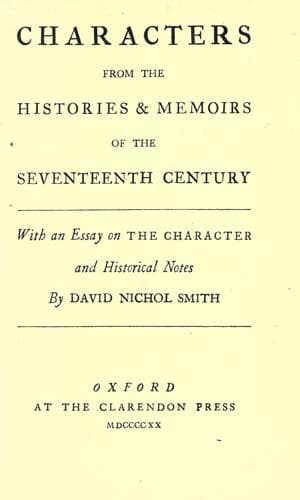
Characters from the Histories & Memoirs of the Seventeenth Century
History
Characters from the Histories & Memoirs of the Seventeenth Century
Great Britain -- Biography; Great Britain -- History -- Stuarts, 1603-1714
The character was published in Leonard Howard's _Collection of
Letters, from the Original Manuscripts_, 1753, pp. 152-5, and was
reprinted in _The Gentleman's Magazine_ for April 1754, pp. 160-1, and
again in _The Connoisseur_, No. 81, August 14, 1755. _The Gentleman's
Magazine_ (1754, p. 215) is responsible for the error that it is to be
found in Peck's _Desiderata Curiosa_.
Hastings was Shaftesbury's neighbour in Dorsetshire. A full-length
portrait of him in his old age, clad in green cloth and holding
a pike-staff in his right hand, is at St. Giles, the seat of the
Shaftesbury family. It is reproduced in Hutchins's _History of
Dorset_, ed. 1868, vol. iii, p. 152.
PAGE 44, ll. 24-26. He was the second son of George fourth Earl of
Huntingdon. Shaftesbury is describing his early associates after his
marriage in 1639: 'The eastern part of Dorsetshire had a bowling-green
at Hanley, where the gentlemen went constantly once a week, though
neither the green nor accommodation was inviting, yet it was well
placed for to continue the correspondence of the gentry of those
parts. Thither resorted Mr. Hastings of Woodland,' &c.
Page 47, l. 12. '_my part lies therein-a_.' As was pointed out by E.F.
Rimbault in _Notes and Queries_, 1859, Second Series, vol. vii, p.
323, this is part of an old catch printed with the music in _Pammelia.
Musicks Miscellanie. Or, Mixed Varietie of Pleasant Roundelayes, and
delightfull Catches_, 1609:
There lies a pudding in the fire,
and my parte lies therein a:
whome should I call in,
O thy good fellowes and mine a.
_Pammelia_, 'the earliest collection of rounds, catches, and canons
printed in England', was brought out by Thomas Ravenscroft. Another
edition appeared in 1618.
15.
Clarendon, MS. Life, pp. 383-4; _History_, Bk. XI, ed. 1704, vol. iii,
pp. 197-9; ed. Macray, vol. iv, pp. 488-92.
The sense of Fate overhangs the portrait in which Clarendon paints for
posterity the private virtues of his unhappy master. The easy dignity
of the style adapts itself to the grave subject. This is one of
Clarendon's greatest passages. It was written twenty years after
Charles's death, but Time had not dulled his feelings. 'But ther shall
be only incerted the shorte character of his person, as it was found
in the papers of that person whose life is heare described, who was so
nerely trusted by him, and who had the greatest love for his person,
and the greatest reverence for his memory, that any faythfull servant
could exspresse.' So he wrote at first in the account of his own life.
On transferring the passage to the _History_ he substituted the more
impersonal sentence (p. 48, l. 27--p. 49, l. 5) which the general
character of the _History_ demanded.
Public-domain text, read in full here on John Shaqi.
Reviews
Reviews
No reviews yet
Be the first to share your thoughts on this work.
Elsewhere in the archive
Join the Discussion
Join the discussion
Sign in to leave a comment or review.
Sign InorCreate an account