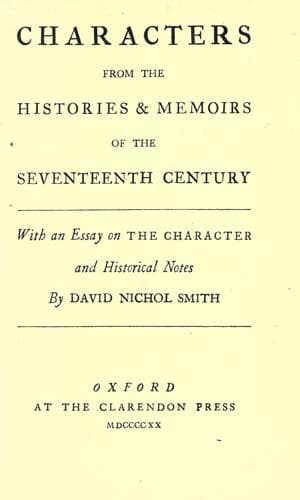
Characters from the Histories & Memoirs of the Seventeenth Century
History
Characters from the Histories & Memoirs of the Seventeenth Century
Great Britain -- Biography; Great Britain -- History -- Stuarts, 1603-1714
This is the portrait of a great English nobleman whose tastes
lay in music and poetry and the arts of peace, but was forced by
circumstances into the leadership of the Royalist army in the North.
He showed little military talent, though he was far from devoid
of personal courage; and he escaped from the conflict, weary and
despondent, when other men were content to carry on the unequal
struggle. He modelled himself on the heroes of Romance. The part he
tried to play could not be adjusted to the rude events of the civil
war.
His romantic cast of mind is shown in his challenge to Lord Fairfax to
follow 'the Examples of our Heroick Ancestors, who used not to spend
their time in scratching one another out of holes, but in pitched
Fields determined their Doubts'. Fairfax replied by expressing his
readiness to fight but refusing to follow 'the Rules of _Amadis
de Gaule_, or the Knight of the Sun, which the language of the
Declaration seems to affect in appointing pitch'd battles' (Rushworth,
_Historical Collections_, third part, vol. ii, 1692, pp. 138, 141).
Warwick's short character of Newcastle resembles Clarendon's: 'He was
a Gentleman of grandeur, generosity, loyalty, and steddy and forward
courage; but his edge had too much of the razor in it: for he had
a tincture of a Romantick spirit, and had the misfortune to have
somewhat of the Poet in him; so as he chose Sir William Davenant, an
eminent good Poet, and loyall Gentleman, to be Lieutenant-Generall
of his Ordnance. This inclination of his own and such kind of
witty society (to be modest in the expressions of it) diverted many
counsels, and lost many opportunities; which the nature of that
affair, this great man had now entred into, required' (_Mémoires_, pp.
235-6).
His life by the Duchess of Newcastle--the 'somewhat fantastical, and
original-brain'd, generous Margaret Newcastle', as Charles Lamb calls
her--was published in 1667. The edition by C.H. Firth, 1886, contains
copious historical notes, and an introduction which points out
Newcastle's place as a patron and author.
Page 116, ll. 15-22. Newcastle had been besieged at York. He was
relieved by Prince Rupert, who, against Newcastle's advice, forced on
the disastrous battle of Marston Moor (July 2, 1644) without waiting
for reinforcements. In this battle Newcastle was not in command
but fought at the head of a company of volunteers. The next day he
embarked at Scarborough for the continent, where he remained till the
Restoration.
l. 24. He published two books on horsemanship--_La Méthode et
Invention Nouvelle de Dresser les Chevaux_, written originally in
English, but printed in French at Antwerp in 1658, and _A New Method
and Extraordinary Invention to Dress Horses_, 1667. The former was
dedicated to Prince Charles, whom, as Governor, he had taught to
ride. On his reputation as a horseman, see C.H. Firth, _op. cit._, pp.
xx-xxii.
Page 117, l. 20. He was Governor of the Prince from 1638 to 1641: cf.
note on p. 115, l. 5.
Public-domain text, read in full here on John Shaqi.
Reviews
Reviews
No reviews yet
Be the first to share your thoughts on this work.
Elsewhere in the archive
Join the Discussion
Join the discussion
Sign in to leave a comment or review.
Sign InorCreate an account