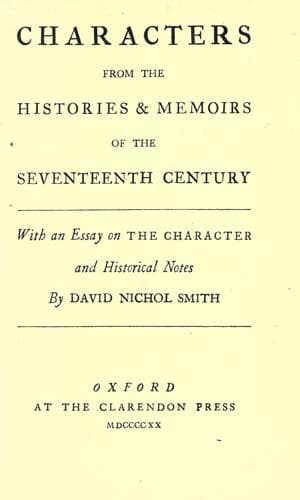
Characters from the Histories & Memoirs of the Seventeenth Century
History
Characters from the Histories & Memoirs of the Seventeenth Century
Great Britain -- Biography; Great Britain -- History -- Stuarts, 1603-1714
l. 29. Newcastle-upon-Tyne (from which he took his title) was
'speedily and dexterously' secured for the King at the end of June
1642 'by his lordship's great interest in those parts, the
ready compliance of the best of the gentry, and the general good
inclinations of the place' (Clarendon, vol. ii, p. 227).
Page 118, l. 17. Henry Clifford (1591-1643) fifth Earl of Cumberland.
He had commanded the Royalist forces in Yorkshire, but was 'in his
nature inactive, and utterly inexperienced'. He willingly gave up
the command (Clarendon, vol. ii, pp. 282, 464-5). He died shortly
afterwards.
l. 28. _this last_, Marston Moor.
Page 119, l. 8. _unacquainted with War_. Clarendon expressed himself
privately on this point much more emphatically than the nature of his
_History_ would allow: 'you will find the Marquis of Newcastle a very
lamentable man and as fit to be a General as a Bishop.' (Letter to
Sir Edward Nicholas, dated Madrid, June 4, 1650: _State Papers_, 1786,
vol. iii, p. 20.)
l. 10. James King (1589?-1652?), created Baron Eythin and Kerrey in
the Scottish peerage in 1643. He had been a general in the army of the
King of Sweden, and returned to this country in 1640. He left it with
Newcastle after Marston Moor. He entirely disapproved of Rupert's
plans for the battle; his comment, as reported by Clarendon, was 'By
God, sir, it is very fyne in the paper, but ther is no such thinge in
the Feilds' (vol. iii, p. 376).
30.
Clarendon, MS. Life, p. 136; _History_, Bk. IV, ed. 1702, vol. i, pp.
270-1; ed. Macray, vol. i, pp. 461-3.
The references to Digby in various parts of the _History_ show the
interest--sometimes an amused interest--that Clarendon took in his
strange and erratic character. 'The temper and composition of his mind
was so admirable, that he was always more pleased and delighted that
he had advanced so far, which he imputed to his virtue and conduct,
than broken or dejected that his success was not answerable, which
he still charged upon second causes, for which he could not be
accountable' (vol. iv, p. 122). 'He was a person of so rare a
composition by nature and by art, (for nature alone could never have
reached to it,) that he was so far from being ever dismayed by any
misfortune, (and greater variety of misfortunes never befell any man,)
that he quickly recollected himself so vigorously, that he did really
believe his condition to be improved by that ill accident' (_id._, p.
175). But the interest is shown above all by the long study of Digby
that he wrote at Montpelier in 1669. It was first printed in his
_State Papers_, 1786, vol. iii, supplement, pp. li-lxxiv. The
manuscript--a transcript revised by Clarendon--is in the Bodleian
Library, Clarendon MS. 122, pp. 1-48.
Page 120, l. 8. _the other three_, Sir John Culpeper, or Colepeper;
Lord Falkland; and Clarendon.
Public-domain text, read in full here on John Shaqi.
Reviews
Reviews
No reviews yet
Be the first to share your thoughts on this work.
Elsewhere in the archive
Join the Discussion
Join the discussion
Sign in to leave a comment or review.
Sign InorCreate an account